

Ernie needed seeing at South Moor Vets at short notice. The poor guy had developed a painful eye, having developed a deep ulcer in the cornea. Unfortunately, Ernie decided that eye drops weren’t for him, no matter how hard his owner tried, and so he had been referred to Optivet for surgery to correct it. (Optivet are a group of ophthalmologists, separate to South Moor Vets, but who work out of our Dartington practice with their own dedicated consulting, hospitalisation and operating theatre).
But my role wasn’t to fix his eye. He had an extra problem - ever since he was young, Ernie had a heart murmur, but it had never been investigated. Now with surgery on the horizon, we had to diagnose his heart condition to see if it was safe to operate.
As vets we refer to a ‘heart murmur’ relatively commonly, and it may be a term you have heard of, but don’t understand what we mean. When the heart beats, there are four valves within the heart that close to stop blood rushing the wrong way. We hear these sounds through our stethoscope. They make a “lub-dub” noise. When there is a heart murmur, we hear a different sound, a “lub-shhhhh-dub” sound. That “shhhhh” sound is an indication to us that there is turbulent blood somewhere within the heart. Sometimes the noise comes in different places within the chest, depending on which part of the heart, or blood vessels, it originates in. It can vary in intensity and duration, lots of subtle variations that give us clues as to what might be causing it. There are other clues too, such as whether it was present at birth, or developed later in life, and what breed of animal we are examining.
The most common way we diagnose the source of a heart murmur is by performing an echocardiogram, which is a heart ultrasound scan. This is done in a conscious patient in most cases, with them lying on a padded table while we scan the heart in real time.
It turned out that Ernie had turbulent blood flow in his pulmonary artery, the main blood vessel leaving the right-hand side of his heart. There was a subtle narrowing of his pulmonic valve, which was causing the blood to speed up, and with some clever settings on my scanner and plenty of training/practice, I’m able to measure the speed of the blood. The faster the speed of the blood, the narrower the valve, and the more severe the 'stenosis'. A good analogy to think of is when you put your thumb partially across a running hosepipe, and the water speeds up and shoots out further - the more you occlude the end of the hosepipe, the faster it shoots out.

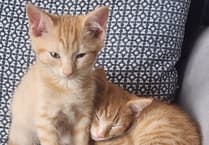


Fortunately, Ernie’s condition, pulmonic stenosis, was quite mild, and he was cleared for his operation at Dartington. At South Moor Vets we have invested heavily in equipment and training so that we can investigate most conditions in house, without having to refer cases up country, meaning patients are treated quickly and with minimal stress. I'm pleased to say that Ernie is recovering well from his operation.
Comments
This article has no comments yet. Be the first to leave a comment.