

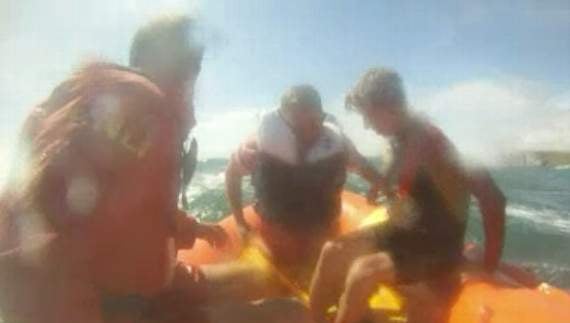
RNLI lifeguards and the Hope Cove Lifeboat rescued a kayaker who became trapped on rocks after he capsized on Sunday.
The sea conditions were rough when RNLI lifeguards Mike Mapson and Sam Sheridan were alerted to the casualty at Bigbury-on-Sea at around 3pm.
An RNLI representative said: “It was a sunny day but there were strong onshore winds and the sea was very choppy with a 0.6m ground swell. The lifeguards were first alerted by the pub on Burgh Island and then by the coastguard, who informed them that a man had been spotted in trouble by members of the public.
“He had climbed onto a rock behind Burgh Island after capsizing and losing his kayak. Due to the surf and currents he had been unable to get himself off the rock and back to safety.”

The lifeguards launched in the inshore rescue boat and requested support from the Hope Cove Lifeboat, due to the casualty’s location. After locating him it became apparent that due to the proximity of the rocks and rough sea conditions the inshore rescue boat would be unable to reach him.
Lifeguard Sam Sheridan entered the water, swam to the casualty and climbed onto the rocks. He secured the casualty with a rescue tube and swam him back to the inshore rescue boat, where senior lifeguard Mike Mapson was waiting to pull him aboard.
The casualty was taken back to the shore where he was reunited with his friend who had been kayaking with him and returned to raise the alarm. All of their equipment was also recovered after the rescue.
Kate Doison, RNLI Lifeguard Supervisor, said: “The casualty was wearing a lifejacket however neither he or his friend had any means of calling for help, meaning his friend had to leave him on his own to raise the alarm.
“Luckily this had already been done by members of the public who had seen the incident unfold and the lifeguards were already on the way to respond.”
The RNLI released a safety message in the aftermath of the rescue: “Of the 16 analysed kayaking and canoeing fatalities from 2010-13, none were able to call for help themselves. In most cases of capsizing, the casualty could not get back in and they remained in the water for over an hour.
“Most are reliant on someone else raising the alarm. The RNLI advises that kayakers should always carry a means of calling for help and keep it within reach.
“To find out more about the different means of calling for help and how to stay safe while kayaking visit the RNLI website HERE
You can see a video of the rescue, taken by the RNLI lifeguards, HERE
Comments
This article has no comments yet. Be the first to leave a comment.