
An iconic British species, first awareness of our native dormouse often occurs in childhood through Lewis Caroll’s surreal classic, ‘Alice in Wonderland’. We don’t learn much about its ecology through the encounter at the Mad Hatter’s tea party, except its propensity for sleeping during the day. As for the teapot, whilst this seems nonsensical, back when dormice were common, they were occasionally discovered curled up asleep in outdoor crockery or discarded flowerpots. Now absent from many former sites and on the UK Red List, classified as Vulnerable in Great Britain and listed as a Priority Species, the hazel dormouse (Muscardinus avellanarius) and sites where it occurs are afforded high levels of environmental protection in law.
As a nocturnally active species of broadleaved woodland and hedgerow, they are rarely encountered and most means of establishing their presence require specialist surveys carried out by suitably licenced professional ecologists. However, evidence of their presence may be detected by the interested amateur, without transgressing the law, through careful searching for discarded hazelnut shells with characteristic signs of gnawing to access the nutritious kernel inside. It was with this intention in mind that my son Oli and I headed off to Lady’s Wood near South Brent for some concerted nut hunting.
I had first heard of this small Devon Wildlife Trust site through Tom Maddock, former Gazette Nature Diarist and locally respected dormouse recorder, who had been a guest guide at a couple of Wildlife Watch Groups when my sons were young. Tom’s relationship with Lady’s Wood had come through the late Henry George Hurrell MBE who lived nearby and had donated the woodland to Devon Wildlife Trust, the organisation he helped to found. It was Henry, together with his daughter, Elaine, who through careful observation had realised that the distinctive features of dormouse-opened hazelnuts could be used more widely as a diagnostic tool to map dormouse distribution across the UK. Shortly afterwards ‘The Great Nut Hunt’ citizen science tool was rolled out and a much clearer picture of the desperate decline of these small mammals emerged as a result.
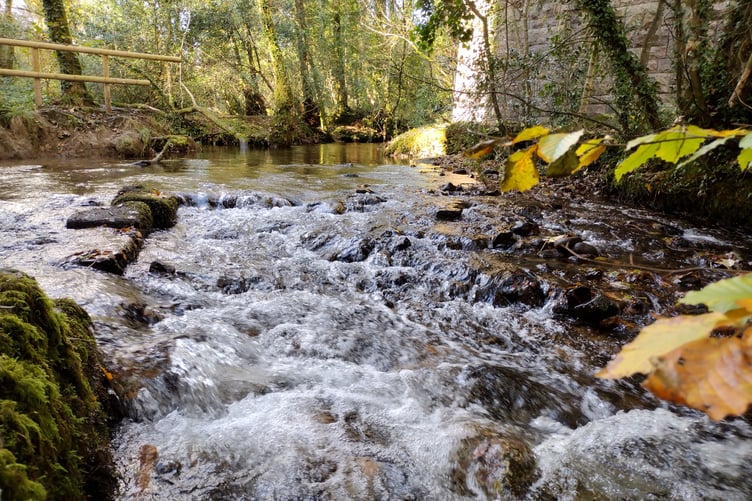
Buoyantly optimistic that the site would be littered with dormouse evidence, Oli and I set off in golden sunshine. We drove down roads we had not driven before despite being so close to home, revelling in the glowing autumn colours: a welcome hiatus between Storm Austen, when the tree canopies were still leafy-green; and whichever storm arrives next to strip them naked in a violent winter reveal. After near empty roads, we arrived at a convenient parking bay. An adjoining path led us along the Glaze Brook, channelled over a metre below us. I wondered how far up the stone walls it would come in a winter spate, given its source waters emanating from the southern slopes of Dartmoor. Further on we found ourselves at the giant granite feet of the towering Glazebrook Viaduct. Here, we were able to get close to the rushing waters, bubbling and splashing between the rocks. This shallower stretch with its stony streambed looked to be an ideal spawning area for trout.
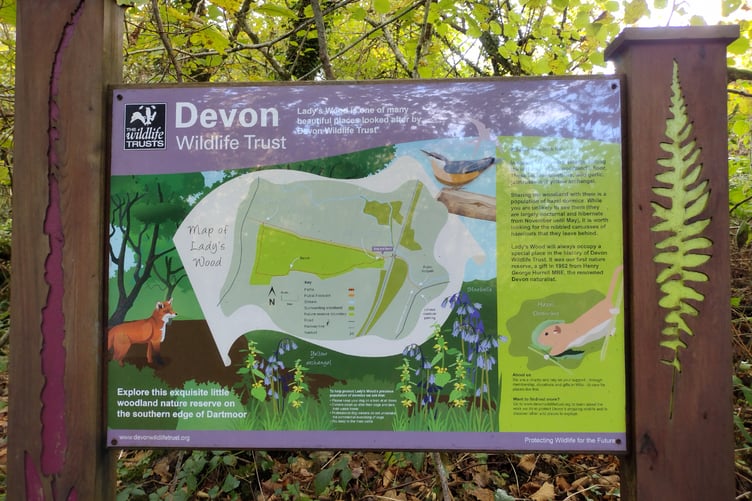
Leaving the brook, we found ourselves at the main entrance to Lady’s Wood and after reading the sign, picked a pathway to follow. Immediately we started the hunt for hazelnuts, fungi and anything else of interest. Greater Spotted Woodpecker could be heard calling out ‘chip-chip’ and Oli shushed me at one point to listen to what sounded like soft tapping in the treetops. Territorial
drumming doesn’t really occur in the autumn so it was more likely to be the sound of a winter roost cavity being chiselled out or a beakful of food being whittled from its hiding place.




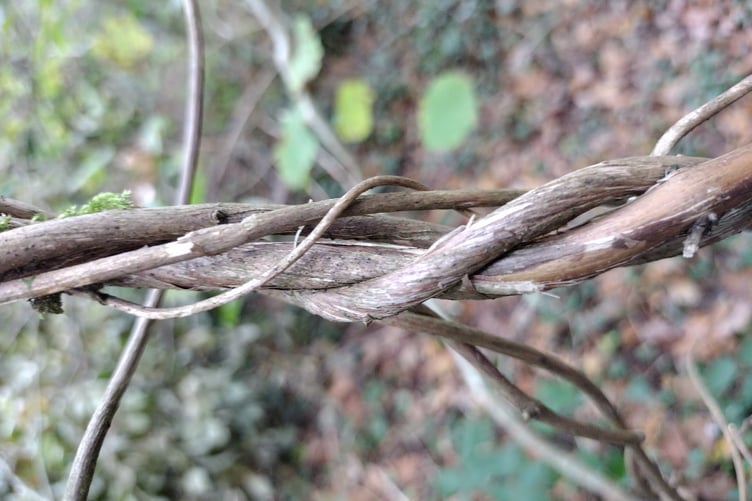
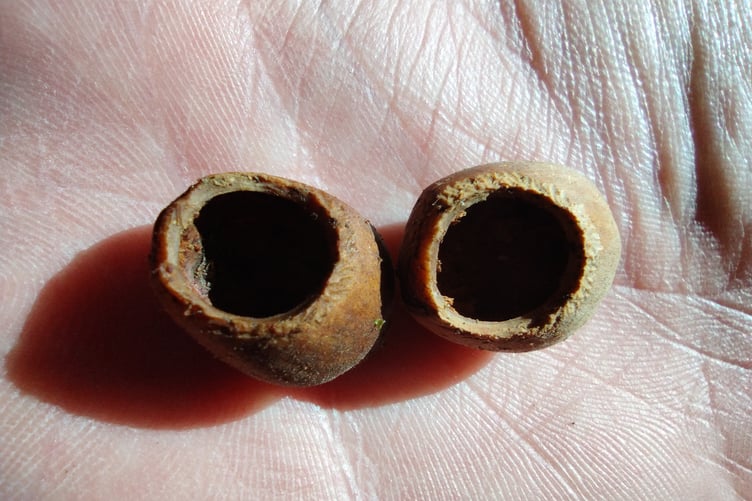
Tall oaks and beech stretched out patterned canopies of yellow and bronze across the blue, met by a filigree of grey fingers reaching out from numerous victims of ash die-back. Below, a continuous mid-layer canopy of hazel intertwined with honeysuckle traversed the woodland. This was perfect dormouse territory where the arboreal night foragers could travel the twining stems to seek out nuts, blossom, buds, seeds and insects, depending on the season, and peel the fibrous, papery honeysuckle bark to weave into summer nests in which to sleep and raise their young. Yet, despite all this promise, my searches bore little reward: a few blackened and worn nutshells, some fresher ones clearly cracked open by squirrels. It wasn’t until we were nearly back at the entrance that my persistence paid off. There, amongst the leaf litter, two perfect dormouse-signature nutshells with the neatest of tiny, circular holes with a smooth inner ring and diagonally radiating toothmarks around the edge. As one of my friends later exclaimed upon examining them, they looked exactly like a pair of miniature wooden clogs!
Comments
We've recently changed our login process. If you have an account for commenting, you will need to re-register on the login window.
This article has no comments yet. Be the first to leave a comment.