
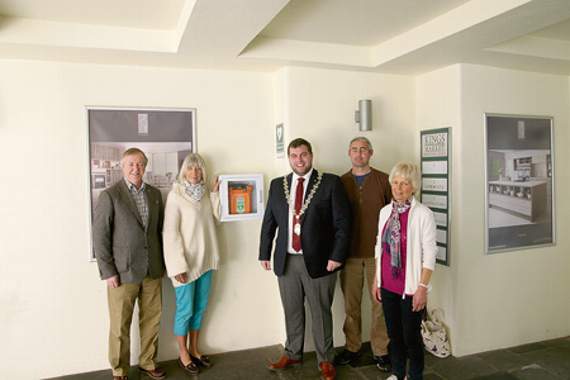
KINGSBRIDGE now has three defibrillators as the town council installs an automatic external defibrillator at the entrance to Kings Market on Fore Street.
This brings the total of open-access defibrillators – those accessible 24 hours a day – to two, with one funded by the Rotary Club of Kingsbridge Estuary located at Ilbert Road Filling Station, and the total for the town up to eight.
AEDs are designed to treat someone suffering from a cardiac arrest by shocking their heart back into a normal rhythm. They are completely automated and give the user step-by-step instructions; they will not deliver a charge unless it is required.
To back up the installation of the new AED in Kings Market, the local Rotary Club, along with president of the Resuscitation Council Carl Gwinnutt, hosted a free Heart Start session in Quay House last week.


Martin Johnson, clerk to Kingsbridge Town Council, attended the session, along with Cllrs Irene Jeeninga, Tom Coulthard and Sandy Gilbert, council staff and 10 members of the public.
Martin shared what he learnt at the session: ‘If you see someone collapse, don’t stop and stare, do something. You can save someone’s life.
‘Shout and shake the victim; if there’s no response shout for help and get someone to dial 999 for an ambulance. Tilt the victim’s head back by lifting the point of their chin and placing your hand on their forehead in order to clear their airway.
‘Look, listen and feel for normal breathing. If the breathing is erratic the victim will be suffering a cardiac arrest. Commence cardiopulmonary resuscitation with chest compressions and rescue breaths to keep blood and oxygen circulating in the body. Get someone to bring one of the AEDs.
‘Kneel at the victim’s side, with the heel of one hand centre of chest, interlock the fingers of the other hand and compress the chest five to six centimetres – 30 compressions at a rate of two per second.
‘Open the victim’s airway, pinch their nose, make a good seal with your mouth to theirs and deliver two rescue breaths, making sure the victim’s chest rises and falls. Then start over again – 30 chest compressions to two breaths – until help arrives. Use the AED.’
An AED used on someone who is suffering a cardiac arrest can increase their chances of survival substantially, from less than five per cent to better than 40 per cent.
An AED is programmed to tell an untrained member of public exactly what to do using recorded voice prompts. It guides a rescuer through the resuscitation process, explaining how to attach adhesive electrode pads to the person’s chest.
Through these electrodes the AED is designed to analyse the electrical activity of the heart automatically to determine if a ‘shockable’ rhythm is present. It tells rescuers to stand back so a shock can be given safely and gives an ‘all-clear’ warning.
The delivery of an electrical shock to a heart experiencing cardiac arrest briefly stops all electrical activity in the heart; this brief break from the previous chaos can be enough for the heart to restart with a normal rhythm. The AED will also advise the rescuer when to recommence CPR.
Mr Gwinnutt, who was helping with the training on Wednesday evening, said: ‘The geography of the South Hams means that the emergency services will often take longer to respond than they would in a city when someone locally has a sudden collapse.
‘Members of the local communities, therefore, need to know what to do in these circumstances. After calling 999, that may mean starting CPR and using an AED.
‘Kingsbridge Town Council and staff have set a great example by being there on Wednesday night and by funding an AED to be installed at the top end of Fore Street.
‘This will benefit not only the local population, but also the many visitors to Kingsbridge.’
Scheme coordinator Steve Kerr and his team covered all aspects of emergency life support at the Kingsbridge Heart Start session and showed everyone present how easy and uncomplicated it is to provide CPR and how to use an AED.
The club has been providing Heart Start training in the local community for five years, with more than 700 people having been trained to date.
The mayor of Kingsbridge, Cllr Wayne Grills, said: ‘In the South Hams, given our rural geography and busy summer roads, we can’t always rely on an ambulance or first responder reaching a casualty quickly enough, which is why we’ve supplied another AED for Kingsbridge town centre.’
The new Kingsbridge AED is now on our defibrillator map at tinyurl.com/southhamsdefibs, or you can use the QR code on the back page of the Gazette. Just download a QR reader onto your smartphone from the Play Store for Android and the App Store for Apple phones.
Comments
This article has no comments yet. Be the first to leave a comment.