

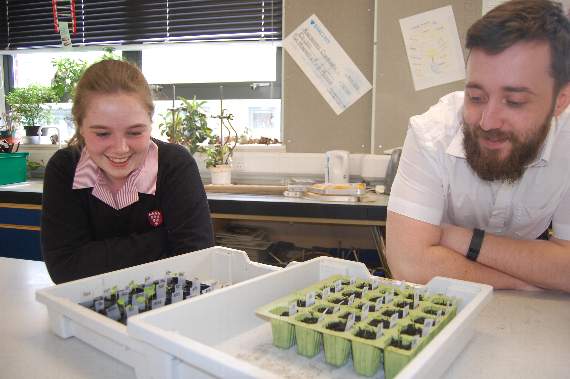
STUDENTS at Kingsbridge Community College and Modbury Primary School have begun their ‘Rocket Science’ experiments.
As part of British astronaut Tim Peake’s mission to the International Space Station, pupils are helping to research how microgravity and space radiation may affect seeds. The experiment is a fun interactive way to get students thinking about how plants might grow in space.
It will help them understand the difficulties of living, growing and eating in future long distance space exploration, such as a manned trip to Mars.
Last autumn two kilograms of rocket seed travelled from Kazakhstan on a Soyuz rocket to the International Space Station. The seeds were stored on the ISS for six months before returning to Earth in Spring.


KCC and Modbury students received two packets of seeds – one red and one blue. They have no idea which seeds have been to space and which are a control group kept here on earth – a so called ‘blind’ experimental design to avoid bias.
Every pupil in Modbury School planted one seed. At KCC, ‘science club’ students planted even numbers of red and blue seeds. The seeds are in identical pots, with identical compost and students are watering them and moving them around to give identical growing conditions.
The experiment will run for a period of 35 days, during which time students will collect and record data from the seedlings’ germination, growth and development.
At the conclusion of the experiment, all 7,000 participating schools will enter their results into a database and the results will be published.
Comments
This article has no comments yet. Be the first to leave a comment.