
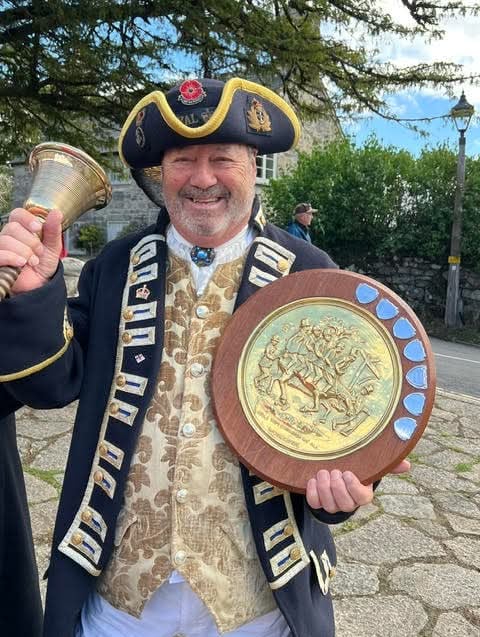
Dartmouth Town Crier Les Ellis has won Best Dressed Crier and came second in the Town Crier competition at Widecombe Fair on Tuesday, September 8.
Les said: “This is a competition I have hosted for the last 8 years after Ken Purchase, Newton Abbot crier retired.
“Widecombe have now appointed their own Crier, Nigel Kenneison who hosted the competition this year allowing me to take part.”
The competition was won by David Green from Torpoint.
And the Kingsbridge town crier Roger Pinder won the Best second cry.
Town criers served as the chief public news announcers and local peacekeepers in communities before widespread literacy and mass media.
Early criers date back to Ancient Greece, including the Spartan runners who spread vital news.
The formalized English tradition grew after the Norman Conquest in 1066 during Medieval times.
Two bellmen even appear on the Bayeux Tapestry.
Because criers spoke for the monarch, harming one was legally treated as treason.



This protection gave rise to the phrase "don't shoot the messenger".
Criers read royal proclamations, patrolled streets after dark, acted as peacekeepers, and announced public punishments or hangings.
Criers used a large handbell to get attention and shouted "Oyez, oyez, oyez!"
This comes from the old French word ouïr, meaning "to listen" ("hear ye").
After reading news at a local inn, the crier would nail the written paper to the doorpost.
This custom created the term "posting a notice" and helped inspire the word "post" for newspapers.
Traditional outfits usually feature a Georgian-style red and gold robe or coat, breeches, boots, and a tricorne hat.
Elsewhere in the South Hams Ivybridge has town crier Martin Stear and Modbury’s is David Scott.
Totnes no longer has a town crier but historically a town crier or ‘bruiter’ featured especially during Elizabethan-themed market days.
Comments
This article has no comments yet. Be the first to leave a comment.