
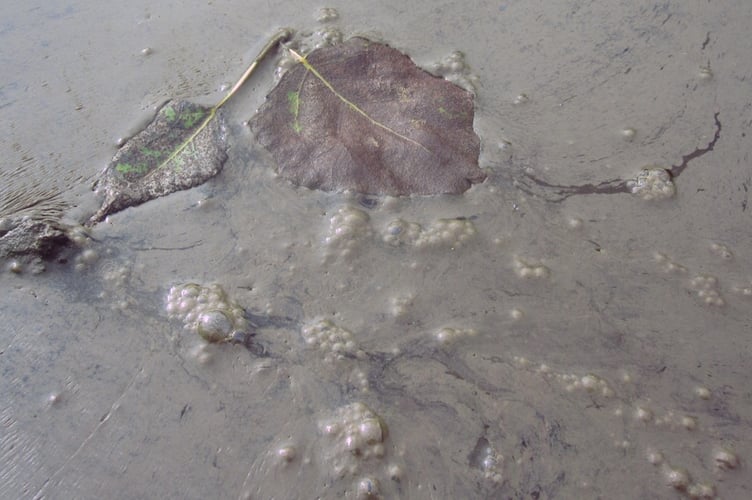
Walking along the top of Kingsbridge Creek this morning, with the tide coming in, starting to flood the creek and bring the mudflats back to active life, I noticed a fine layer of scum floating on the surface of the water. Depending on the conditions, this scum can vary in how thick and frothy it is, but it always looks ‘dirty’ and will coat anything that floats through it. In the warmth of summer (I wish!) the scum can even smell of the estuarine mud from which it comes - not very pleasant and more of a sulphurous ‘rotting egg’ smell.
I always listen out for exclamations of disgust from my fellow walkers, in case I can help interpret for them a more positive picture of what is happening in front of them. There is a similar occurrence with each incoming tide, when the weather conditions wash and blow it in, and across every one of our estuaries.
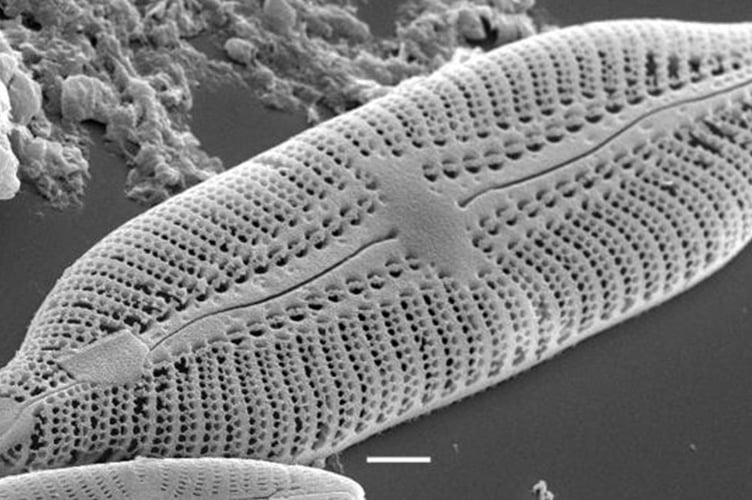
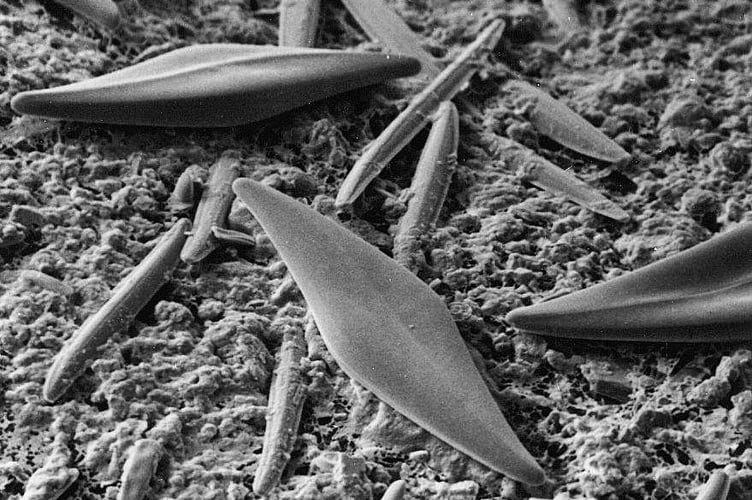
The frothy scum is simply a slightly oily mass of what the incoming tide picks up from the estuarine mudflats. The flow and wind, if acting together, concentrate and drive the scum up the shore at the head of that tide. A high proportion of the scum, and the source of its clingy oiliness, comes from microscopic single-celled seaweeds called diatoms. There are thousands upon thousands of species of diatoms that thrive in most aquatic environments. Most are planktonic within the water, but a few species of estuarine mudflat diatoms have adapted to thrive in the topmost layer of the mud.

Seaweeds, like plants, are photosynthetic – using energy from the sun to make their own food from water and carbon dioxide. Many seaweeds and plants make a form of sugar as their food, but our estuarine mud diatoms produce more of an oily substance. They use this to help themselves glide through the surface of the mud as they migrate up towards the sun and down back into the mud with darkness and the tides … these are seaweeds that can move! Most seaweeds are simply floppy and float, so that they float up towards the sun with the tides (and many plants grow up tall towards the sun, although seagrasses follow the seaweed floatation trick).
Take a view over a mudflat at low tide on a sunny day, and that glowing golden-brown sheen over the surface is a mass of these diatoms that have migrated to the surface to effectively sunbathe – a mass migration of millions of millions of diatoms. A beautiful consequence of all these diatoms is that the oil they use to glide also helps stabilise the surface of the mud, keeping the water clearer … and, of course, the oxygen that they discard during the photosynthesis, which is rather handy to all us animals!
They are microscopic, so out of the range of a magnifying glass, but well within the realms of a home microscope if you have one. Simply place a single ply of toilet paper over some golden-brown estuary mud on a sunny day from a safe position. Leave it there for 10-15 minutes for the diatoms to chase the sun. Carefully place a part of the paper on your microscope slide and irrigate it with a drop of seawater and look for slightly lemon-shaped lifeforms – those are your estuarine mudflat diatoms. Don’t be surprised to find other tiny organisms moving around too – anything from tiny nematode worms to stranded plankton.
Diatoms need more than just the ‘oil’ to grow, requiring minerals, that they get from the water and muddy sediments, and nutrients, many of which are made available in the same mud by naturally occurring bacteria. These naturally occurring bacteria get their energy from breaking down some of the organic debris (‘detritus’) that settles within our estuaries, arriving from both from their rainwater catchments and the sea. If this all sounds horrible, please be assured that this is entirely natural to estuaries – they are nature’s catchment waters treatment systems. Throughout the year, tons of organic-rich sediment washes into our estuaries, supporting bacterial populations in numbers that are hard to imagine. It is estimated that just four teaspoons of estuarine mud support as many bacteria as there are people on our planet … truly astronomical numbers! (We use similar systems to break down our own waste, but then we need to be very careful where we release this nutrient-rich effluent).
All those diatoms and bacteria are the ultimate drivers of our estuarine ecosystems, they are the estuaries’ primary producers, upon which most of the web of life that live in, migrate to, or even live around estuaries, depends.
As so often in nature, there is a fine balance. In some of our estuaries they are now receiving too much in the way of already broken-down nutrients from right across their catchment community – from farming, horticulture, our kitchen sinks via waste treatment systems (private too) to nutrient-rich car-wash detergents. These excess, and importantly immediately biologically available, nutrients can and do fertilise harmful algal blooms such as green blankets of seaweed that stifle the diatoms and usual ecology that graze upon them.
Now that I hope we understand a little more of what make our estuaries tick, the answer lies in all our hands: to all do our own bit to reduce our nutrient footprint downstream.
Comments
We've recently changed our login process. If you have an account for commenting, you will need to re-register on the login window.
This article has no comments yet. Be the first to leave a comment.