

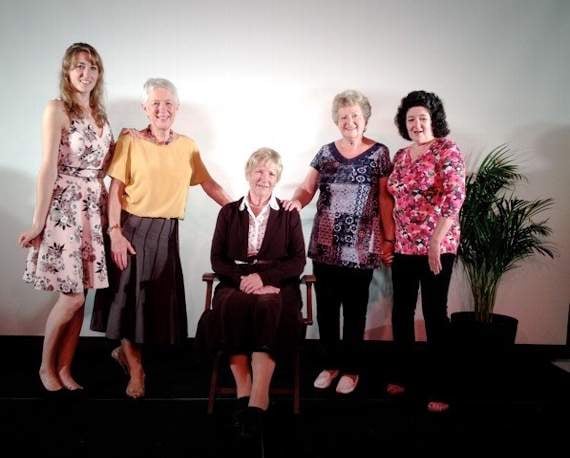
Monday night in a seaside town doesn’t usually offer much in the way of entertainment but The Salcombe Players managed to disprove this theory with a recent production of No Woman is an Island.
Written by local playwright, Malcolm MacIntosh, it was a series of monologues by five different women of varying ages and temperament that kept a capacity audience intrigued and engaged.
Monologues are challenging for the actor, presenting the need for an immediate rapport with the audience and with nobody else on stage to offer support should there be a wobble.
It’s an intimate environment and, in this production, with a bare minimum of stage dressing: a table and a chair against a white background and a large pot plant to one side.



Christine Bonner, the director, rang the changes between characters with a different tablecloth and a minimum of props: a framed photograph, a lunch box, an invitation card, an M&S shopping bag, or in the case of the eternal pessimist, an umbrella.
Each item was carefully chosen to link to the monologue and give clues to the separate but ultimately linked themes.
The women themselves are the sort you meet in every community, in this case suburban Surrey. We know them - or do we? They ranged in age from 25 to mid-80s and each spoke to us for about 15 minutes and gave a snapshot of what was currently preoccupying them.
There were insights into pessimism, disappointment, resentment, fear and loneliness in the first half, with each one determined to keep up a good public front.
Jill, played by Wendy Morrall, was an outgoing elderly adventurous lady always out and about on the bus and giving the impression that she had lots of friends to visit in the area. But, no, we discovered, she couldn’t afford to heat her little bungalow apart from one bar on the electric fire in one room every evening - “put another jumper on I say”.
The apparent social gadfly was using her free bus pass to keep warm on public transport.
The characters gradually revealed their inner thoughts and fears, or in the case of Joyce, played by Jackie Hodges, her glass half-empty reflection on a disappointing marriage and an inability to understand why anyone could be cheerful in the face of adversity.
She was also facing redundancy from her beauty counter, where perhaps the skill of applying a mask of make up helped to overcome the private face of bitterness.
Lindy Sinnott, Wendy Read and Sarah Montague played the three other characters with equal skill and empathy. Wendy Read’s timorous Josie was a study in indecision and rectitude while Sarah Montague’s Jenny was a right-on bus driving feminist who seemed full of confidence but who was desperate for her mother’s approval.
Lindy Sinnott as Janice longed for a romantic gesture from her husband of fifteen years, such as she had glimpsed scribbled in the margins of her escapist charity shop book.
So we came to the end of the first half pondering how on earth these characters would develop and what would happen to ease their situations. Act Two brought gentle resolution to most of them: Joyce decided to take redundancy and become a community volunteer, Janice provoked a romantic response from her undemonstrative husband and Josie made a decision!
Jenny’s unconventional love life received her mother’s approval and, poignantly, Jill met up with her brother Bobby.
This was a subtle and satisfying production with several common themes of isolation, pride, disappointment, betrayal but, ultimately, hope and anticipation of change and fulfilment. The cast and director are to be congratulated on such fine performances of Malcolm MacIntosh’s thoughtful writing.
What an enjoyable Monday night it turned out to be.
Comments
This article has no comments yet. Be the first to leave a comment.