
SOUTH Hams residents were remembered this week as VJ Day, September 2, marked the 70th anniversary of the end of the Second World War.
This was the date, 70 years before, that saw the formal surrender ceremony of Japan in Tokyo Bay aboard the US vessel the USS Missouri.
The surrender followed the dropping of two atomic bombs on Hiroshima and Nagasaki on August 6 and 9, which killed up to 246,000 people.
The date will be marked by many people in the South Hams, with Jason Sullock using the date to remember members of his family and the sacrifices they made during the Second World War.

One side of Jason’s family, the Sullocks, lived in and around Bigbury Bay until the turn of the 19th century. He thinks they were mainly a mix of carpenters, builders, farmers and shipowners since 1660, including a ‘sprinkling of smuggling’ out of Guernsey.
In the early 1900s, John Sullock and his son John Henry Sullock moved to London to set up a building firm. Charles (Charlie) Sullock was born in 1905 to a comfortable house complete with servants and horses, but his father, John Henry, who family history remembers
as a ‘bit of a dandy’, had lost a reasonable-sized fortune by the time Charlie was grown.
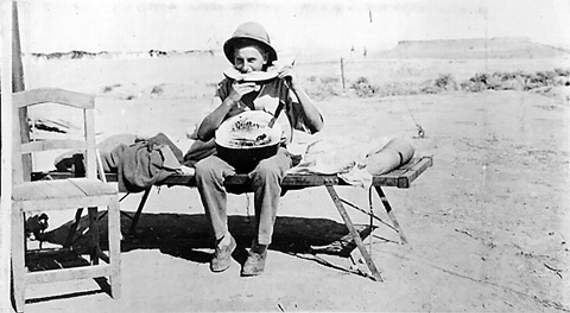
Charlie joined the recently formed RAF in 1924 as a boy entrant to ‘make his way in the world’ and was sent immediately to Mesopotamia, or ‘Mespot’, now modern Iraq, where he rose through the ranks to become a WOPAG – a wireless operator/air gunner.
These were dangerous times in that part of the world, as they continue to be, with Charlie flying in aircraft that had changed little since the First World War, and he was shot at regularly by Kurdish forces, who were fighting for an independent country, and Turkish forces, who were fighting to reclaim Iraq after the war.
Jason explained that his grandfather recounted stories of a time when ‘life was cheap’. Tales of ‘donkeys being worked to death because of Whitehall budget cuts’, of ‘aircraft turning over on landing and burning pilots to death because of defective RAF batteries’, and ‘inter-tribal warfare being punished with bombings’.
He said ‘peace, of a sort, was kept largely because the RAF stopped the various tribes killing each other over family vendettas and religious tensions’ and that photos of Charlie show that it wasn’t easy, with Charlie looking a somewhat ‘thin, gaunt figure’.
Charlie was then posted to India and the North West Frontier, spending three years being ‘chased up and down the radio dial’ by Soviet spies trying to jam his transmissions, while staying alert for an invasion of the airfield by the Pashtuns, the people of southeastern Afghanistan and northwestern Pakistan.
Jason says his grandfather’s abiding memory of the time was of an Airman Ross, ‘a weird bloke who spent most nights after lights out writing his diary under the bedclothes with a torch – who turned out to be TE Lawrence, Lawrence of Arabia, and who was frogmarched out one day by the Military Police.’
Charlie returned to the UK in 1933 on leave, but he was involved in a motorcycle accident that saw him medically discharged from the RAF. He was recalled on the first day of the Second World War as part of the RAFVR – the Royal Air Force Volunteer Reserve – to fly Halifax bombers over Nazi Germany as a wireless operator.
He was mentioned in dispatches for one of these flights as a cannon shell came through the fuselage and hit the wireless, which burst into flames and burnt the Bakelite headphones on Charlie’s head, leaving him with a permanent loss of hair along the banding where the headphones had been.
Despite this, following his recuperation, he was commissioned as a flight lieutenant and posted to Limervady in Northern Ireland to fly Sunderland flying boats over the merchant convoys that were bringing aid and troops from the US. He ended the war in charge of between 20 and 30 of the Women’s RAF who were stationed at RAF Thornaby in the northeast of England.
After the war he joined the wireless and television repair industry, into which his son, Jason’s father David Sullock, followed him. He died in 1965.
One final anecdote Jason told about Charlie and his brother Bill took place after the war, while they were visiting Ivybridge for the funeral of a relative.
‘They were chatting together on the local bus,’ related Jason, ‘when a stranger, on seeing them, turned and said, “I know you. You’m be Sullocks of Bigbury”.
‘My father always said it was their Roman noses that gave them away, but their facial features must have been striking enough to have been obvious even then.’
Despite being raised in London and building a life on Teesside, Jason said that Charlie ‘never forgot his roots, always gravitating back to Torbay and the South Hams for holidays and family’; so much so, said Jason, that he and his parents ‘continue to feel that South Devon is our home, and I personally feel a great longing each year to be back there’.
The other side of Jason’s family, the Sullock-Enzlins from Holland, survived the Japanese concentration camps in the Dutch East Indies, and Jason is in the process of researching that side.
Remembering his family on VJ Day this week, Jason concluded: ‘They truly were the greatest generation and I’m proud to walk in their shadow.’
Comments
This article has no comments yet. Be the first to leave a comment.