
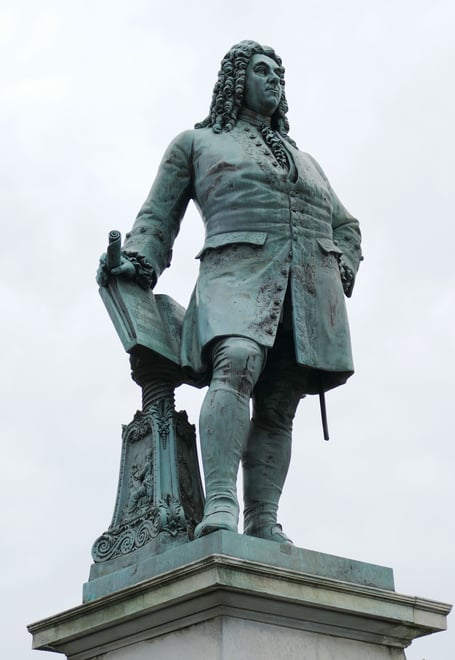
It was against all odds that the composer Handel became a musician at all. His father intended him for a legal career and music played no part in his early life. A friend gave him a clavichord and Handel taught himself to play. From then on, there was no contest between law and music. He became a talented composer spending time in Italy performing his work. His gifts took him across Europe, achieving modest success, but with no financial support.




In the early 1700s Handel settled in London, but his health declined and at 53 he suffered a stroke, losing his income, inspiration and hope. However, one evening, returning to his lodgings, he found a libretto of a sacred oratorio, and with it a note, “The Lord gave the word.” urging him to set the words to music.
A line from the text struck him deeply: “He was despised and rejected of men.” Handel felt an overwhelming connection to the text and read on: “trust in God and He will give you rest.” Profoundly moved, he began to compose. For 24 days he worked without rest; writing, singing, and weeping as Messiah took shape.
With his reputation fading in London, he premiered Messiah in Dublin, declining payment and instead directing all proceeds to charity. He considered the work a miracle that had lifted him from his own despair. At its London debut on 13th April 1742 on hearing the “Hallelujah” chorus, the entire audience, led by the king, rose to their feet.
For the next 17 years Handel presented Messiah annually and although he later went blind, he never again succumbed to despair. Handel died on Good Friday 1759, leaving behind one of the most frequently performed, beloved and enduring choral works ever. Hallelujah indeed!
Comments
We've recently changed our login process. If you have an account for commenting, you will need to re-register on the login window.
This article has no comments yet. Be the first to leave a comment.