
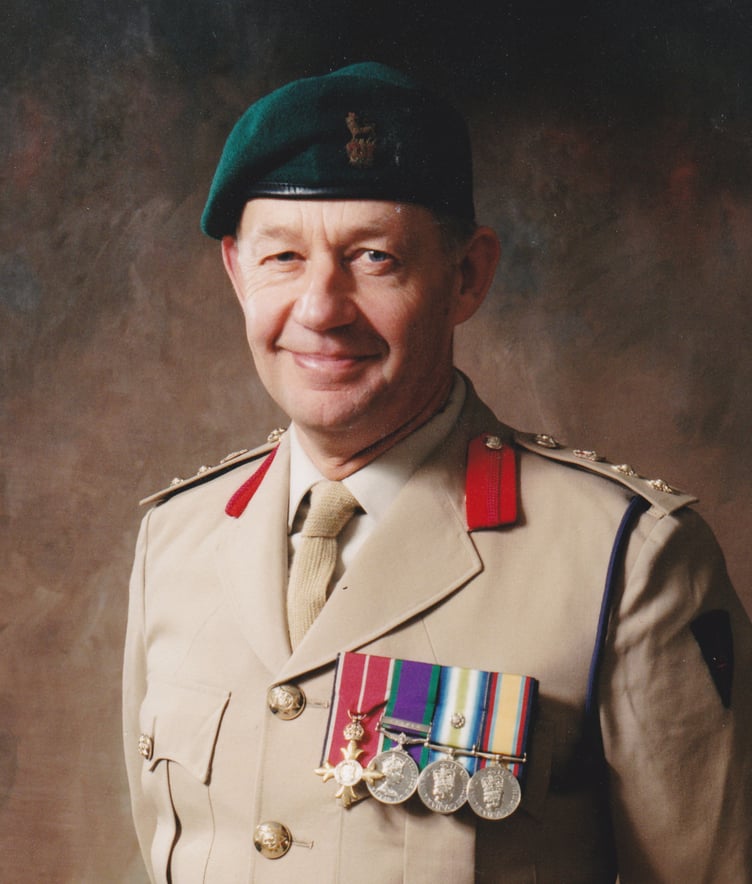
A former Royal Marines commanding officer who helped keep British forces supplied during the Falklands War will give a personal account of the brutal 1982 conflict.
Lieutenant Colonel Ivar Hellberg OBE was the commanding officer of the Commando Logistics Regiment, based in Plymouth, when Argentina invaded the Falkland Islands on April 2, 1982.
With only 72 hours to prepare, his regiment helped load around 12,500 tons of War Maintenance Reserve supplies aboard 18 ships before the task force sailed 8,000 miles to the South Atlantic.
Ivar said: "We were just coming back from Norway, from our three months' training in North Norway.
"So our units in the three commanding brigades of Royal Marines were pretty well worked up.
"We had 72 hours' notice, basically, to get out loaded with some 12,500 tons of WMR, War Maintenance Reserve, into 14 to 18 ships."
After stopping at Ascension Island to reorganise supplies for an amphibious landing, his regiment became the hub of the operation's beach support area, responsible for everything from fuel and ammunition to landing craft and medical facilities.
The regiment established a field hospital at Ajax Bay, where supplies were brought ashore to support the fighting forces.
Ivar said the British were fortunate not to encounter major Argentine units where they landed, saying that the outcome could have been very different.
"If the Argentinians had got their tactics or their strategy right and anticipated where we might land, then we could have taken 20 per cent more casualties," he said. "So we were very lucky because Normandy, Gallipoli, Salerno- all those, if you study those, the casualty rate was enormous."


The fighting brought other challenges to British Forces; with virtually no roads across the islands, supplies had to be transported by helicopter or landing craft, while troops crossed boggy ground and rocky terrain on foot.
"The weather was absolutely awful; it was really cold, with heavy winds," Ivar said.
"The wind in the Falklands was something else.
"So everybody was really cold and suffering from trench foot, but I think most people got trench foot because your feet never really dried out."
His regiment was also given responsibility for Argentine prisoners of war, despite not having planned to accommodate thousands of captives.
“We had to construct a camp also in the hub area of Ajax Bay,” he said.
Ivar said his sappers built cages and used canvas from ships to provide shelter, while the regiment also organised food for the prisoners.
Following Argentina's surrender on June 14, the regiment moved to Port Stanley to support the British garrison, where it took responsibility for around 12,500 Argentine prisoners of war.
The surrender brought further challenges, with Argentine forces having destroyed much of the town's essential infrastructure, including its water, electricity and sewage systems. Ivar said his regiment's engineers and technicians had to help restore these services.
Ivar said his regiment lost seven men with 27 seriously wounded, adding that he had anticipated considerably heavier casualties.
He has since returned to the islands and developed lasting friendships with residents.
He also remains in contact with some former Argentine prisoners.
"I wish other nations who are involved in combat would actually look out for or give respect to prisoners of war," he said. "It doesn't cost you anything to be civil to them and try and look after them."
Ivar attended a commemorative service at Ajax Bay two years ago for a memorial to members of his regiment who died during the conflict.
He will share his experiences with the South Hams History Forum at Wembury War Memorial Village Hall this evening Thursday October 15, with the talk beginning at 7.30pm.
Comments
We've recently changed our login process. If you have an account for commenting, you will need to re-register on the login window.
This article has no comments yet. Be the first to leave a comment.