

The Torbay and South Devon NHS Foundation Trust has announced a major new investment in robotic surgery at Torbay Hospital, supported by Torbay Hospital League of Friends, who are contributing 40 per cent of the £1.3 million cost of a new surgical robot.
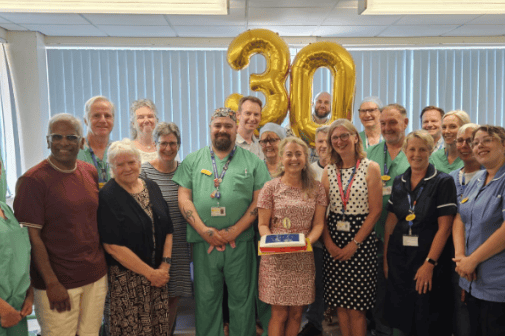
The investment coincides with 30 years of day surgery at Torbay Hospital, marking three decades of developing safe and effective care.
Trust leaders say the move builds on a long-standing commitment to improving surgical services through innovation.
The decision follows a six-month pilot of the Versius robotic surgery system, provided under a no-cost loan agreement, allowing surgical teams to assess the technology in real clinical use before committing to purchase.
Versius is a modular robotic platform designed to support inpatient and day case surgery across a range of specialties, including upper gastrointestinal, colorectal and general surgery.
Its adaptable design allows it to be used across different theatre environments and procedures, supporting minimally invasive techniques.
During the pilot, the surgical team carried out what is believed to be the world’s first robotic day case colectomy, with the patient discharged home the same day.
It also completed what is understood to be the UK’s first day case high anterior resection, alongside the first day case intra-thoracic stomach repair in the South West.
These milestones demonstrate how advances in robotic technology are helping to expand day surgery at Torbay, enabling increasingly complex procedures to be carried out safely without an overnight stay.
Robotic-assisted surgery allows surgeons enhanced vision and greater precision compared with standard keyhole surgery, using small incisions that can reduce post-operative pain, minimise scarring and support faster recovery where clinically appropriate.
-Kevin-Dixon-(Chair-Health.jpeg?width=209&height=140&crop=209:145,smart&quality=75)



For patients, this can mean less time in hospital and a quicker return to normal activities, while maintaining high standards of safety and care.
Mr Adam Kimble, Clinical Service Lead for General Surgery and Urology and Consultant General and Colorectal Surgeon, said the pilot had been an important opportunity to evaluate the technology in a real-world setting.
“The pilot period gave us the opportunity to assess robotic surgery properly in our own theatres, with our own teams and patients. Being able to take that step before investing was hugely important’, he said.
“The early experience has shown how this technology can support high quality, minimally invasive surgery and help us continue to develop our surgical services here in Torbay.
He added: “For patients, one of the most important things is how they feel after surgery.
“What we’ve seen is that robotic assisted surgery can support a faster recovery, with less pain, enabling a quicker return home for procedures such as gallbladder removal, hernia repair, hiatus hernia repair and bowel cancer surgery.”
The Trust said it will continue to develop its robotic surgery programme in a phased, clinically led way, with ongoing focus on patient safety, outcomes, experience and workforce training.
Peter Gorham of CMR Surgical said the investment highlighted the growing value of robotic-assisted surgery in improving efficiency and patient flow, while John McGrath of NHS England’s Robotic Surgery Steering Committee described Torbay’s programme as an “exemplar” for future NHS robotic services.
Comments
We've recently changed our login process. If you have an account for commenting, you will need to re-register on the login window.
This article has no comments yet. Be the first to leave a comment.