
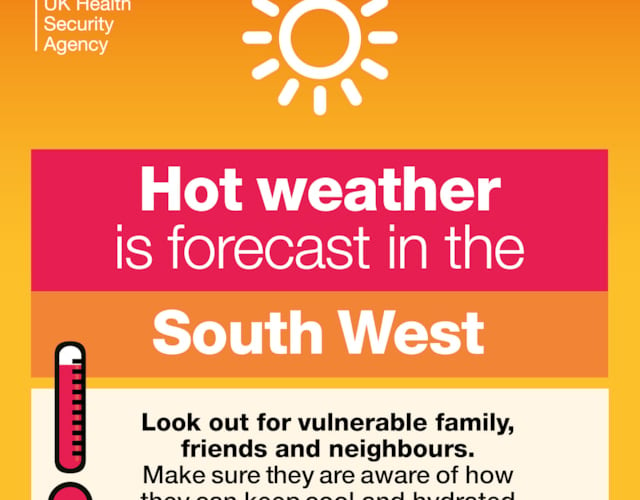
THE UK Health Security Agency (UKHSA) has escalated its heat-health alert (HHA) for the South West from yellow to amber, warning that high temperatures pose an increased risk to vulnerable people and reminding health and social care services to prepare as temperatures continue to rise.
An amber Heat-Health Alert is now in place for the South West from 10am on Tuesday May 26 until 5pm on Thursday May 28.
Under UKHSA and the Met Office's Weather-Health Alerting System, an amber Heat-Health Alert means that impacts will likely include: increased use of health care services by vulnerable populations and an increase in risk to health for individuals aged over 65 years or those with pre-existing health conditions, including respiratory and cardiovascular diseases
Dr Chaam Klinger, Consultant in Health Protection at UKHSA South West, said: ‘We want those living in and visiting the South West, particularly for half term to enjoy the good weather this week.
‘However, we know that even moderate heat can lead to serious health problems, especially for older people and those with certain health conditions, so it's important that everyone takes simple precautions while enjoying the warm weather over the coming days.
‘If you have friends, family or neighbours who are more vulnerable, it is important to check in on them and ensure they are aware of the forecasts and are following the necessary advice.’
The South West's coastline, rivers and open water also present additional risks during hot weather.
Cold-water shock can affect even strong swimmers when entering cold water on a hot day, and water-related incidents typically increase during periods of high temperature.
People are advised to swim only at designated, supervised locations and to keep a close eye on children near any open water.
There are simple steps to keep safe during periods of hot weather.
.jpeg?width=209&height=140&crop=209:145,smart&quality=75)


Keep your home cool by closing windows and curtains in rooms that face the sun.
If you do go outside, cover up with suitable clothing, such as an appropriate hat and sunglasses, and seek shade and apply sunscreen regularly.
Keep out of the sun at the hottest time of the day, between 11am and 3pm.
If you are going to do a physical activity (for example, exercising or walking the dog), plan to do these during times of the day when it is cooler, such as the morning or evening.
Know the symptoms of heat exhaustion and heatstroke and what to do if you or someone else has them.
Comments
We've recently changed our login process. If you have an account for commenting, you will need to re-register on the login window.
This article has no comments yet. Be the first to leave a comment.