

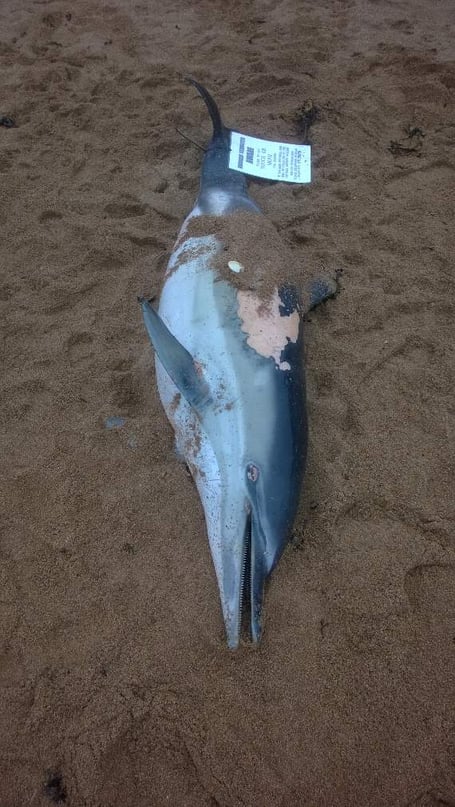
A COMMON dolphin that was washed up on Thurlestone Sands on Sunday was probably a victim of bycatch.
A large adolescent male common dolphin was washed up on the beach on Sunday, December 6, and Hope Cove Coastguard, who moved the body up and out of the surf, notified Lindy Hingley of Brixham Seawatch. This allowed Lindy to organise someone from London Zoo to pick up the dolphin and take it for a post-mortem investigation.
‘It was nearly fully grown’, said Lindy, ‘a large juvenile male. I suspect it was a victim of bycatch, but it lacked some of the more common signs such as a broken beak. But it did have cuts to either side of its mouth and behind the pectoral fins.’
Of all the dolphins transported to London Zoo for post-mortems, 80 per cent are victims of bycatch – being caught up in trawler nets – and the remaining 20 per cent have signs of illness, old age or starvation.



Some dolphins and other cetaceans can also ‘live strand’, meaning they strand themselves on the beach and are unable to get back to the ocean. Sometimes they are fishing in shallow water and go too far, sometimes they are chased into the shallows, but Lindy doesn’t believe this is the case with this individual.
There were signs of old scars on the dolphin, which Lindy puts down to interactions with other dolphins. ‘At the age he was, he was like a big teenager, so there will have been competition between the males in his pod’, she explained, ‘they also interact with bottlenose dolphins and they can get aggressive.’
Dog walkers and other members of the public were there while Lindy was tagging the dolphin and were very interested to learn what happened to him.
‘The children were asking questions and the parents were keen for them to learn’, continued Lindy. ‘It’s really important that children know that these animals are off our coastline and that they are threatened.’
If you see a whale, dolphin or porpoise washed up on the beach, contact Lindy at Brixham Seawatch on 07712 587799. You can learn more about the threat of bycatch at the WWF website: www.worldwildlife.org/threats/bycatch
Comments
This article has no comments yet. Be the first to leave a comment.