

Residents of Bigbury-on-Sea are celebrating the Bay View Cafe being listed as an asset of community value.
As an ACV, the current owner must inform the local authority if they wish to sell the cafe. And if a community group wishes to buy the cafe, the process of selling can be delayed by six months to give the community the chance to raise the money to buy the “asset”.
However, the ACV doesn’t mean the owner has to sell to the community group, and only gives the group more time to raise necessary funds.
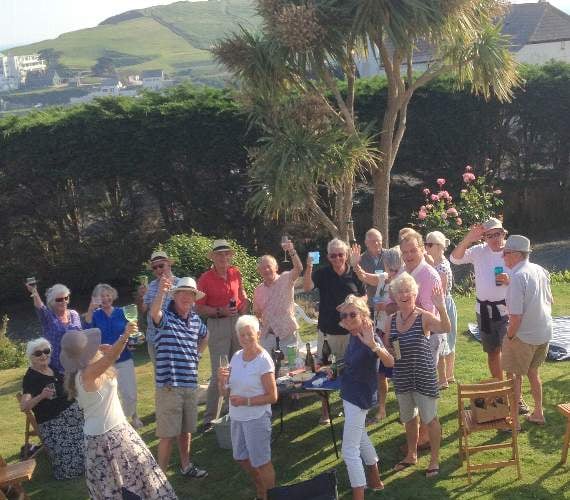
An impromptu gathering in the garden of Mariners, Bigbury-on-Sea celebrated the Bay View Cafe’s listing last week, with Liberal Democrat district councillor Elizabeth Huntley raising a toast to “the future of the cafe”, immediately above the Bay View Cafe.




The campaign to have the cafe listed as an asset of community value was initiated by former Conservative district councillor Lindsay Ward, supported by Bigbury Parish Council and continued by Cllr Huntley - elected in February following Cllr Ward’s resignation.
Cllr Huntley said: “The Bay View Cafe was the glue that held the community. It’s been ripped away from us and we never wanted it to go.”
The Bay View Cafe closed its doors “abruptly” in September 2015, and more than 80 people turned up to the farewell party. The cafe was popular with residents and visitors alike, and had a Certificate of Excellence from the website Trip Advisor, with many positive reviews written by members of the public.
Cllr Huntley explained that as a community asset, the cafe’s future success will be measured, not by profit, but by its value to the community. There are ideas in the village for a rejuvenated Bay View Cafe - including a little shop selling local goods, a bar opening in the evening for young people, and the hope that the cafe could be open all year round (previously, the cafe would open for six months of the year, from March until September).
Bigbury-on-Sea has suffered several hits to community life in recent years, with the loss of the village’s post office, the Royal Oak in Bigbury (only a mile up the road) and increasingly erratic opening hours at the Pilchard Inn on Burgh Island.
Since the cafe closed in September 2015, plans have been submitted and twice rejected in 2016 to demolish Warren Cottage and Bay View Cafe for firstly three, detached houses and latterly, four detached homes, along with the demolition of the existing Warren Cottage and Bay View Cafe.
The most recent application, refused by SHDC in October last year on the grounds that “the proposed change of use would result in the loss of a community facility, tourist asset and an employment use without adequate justification” and “the loss of the community facility, tourist asset and employment use, together with the demolition of a building of local interest considered a non-designated heritage asset, fails to address the connections between people and places and leads to the loss of local distinctiveness and the degradation of the sustainability of the settlement”.
An attempt was made to achieve listed status for Warren Cottage, and although this was unsuccessful, Historic England acknowledged that the property had “local interest” as it was the “first dwelling erected on the mainland” within what would become Bigbury-on-Sea.
In February 2016, the first application was also refused, based on lack of sufficient information that “the cafe is no longer viable or that it has no prospect of continuing to provide social and economic benefit” and that the development “does not deliver sufficient social, environmental or economic benefit to outweigh the harm associated with the loss of the undesignated heritage asset”, along with other concerns relating to the design of the buildings and their setting in the village.
The officer’s report also focussed on the “community functions” that public houses and cafes serve in communities, and the fact that they are “especially pronounced in isolated rural communities, such as Bigbury-on-Sea” and that the Bay View Cafe “represents the only example within the village of a contained, indoor public area for people living in the village to socialise and gather”.
The report added that “the loss of this community facility is in conflict with planning policy at the local and national level” and that “its closure was undertaken by the applicant and does not indicate an absence of proven demand”.
The two applications received dozens of letters of representation in opposition to the development from both residents and visitors.
Comments
This article has no comments yet. Be the first to leave a comment.