
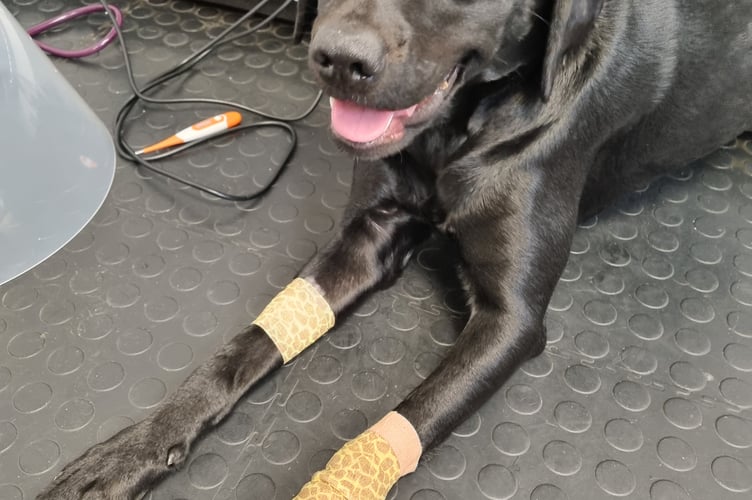
I think anyone familiar with Labradors will know that they are generally fairly robust dogs, but they can easily damage their nails as they tear around at full speed! Rodney arrived at South Moor Vets on a Winter’s afternoon – looking as though nothing had happened and was more interested in getting to the biscuit jar than being examined! However, his owner had noticed that he was lame on his left foreleg and seemed to have a small split in the nail.
In fact, when I tried to examine it, the level of pain was significant. Rodney needed us to examine his damaged nail more closely so he had to be admitted for sedation.
Once he had an intramuscular injection of sedative, he quickly became much calmer; we could see that the nail was split in two places.
Sometimes we can clip the claw short above the crack. Unfortunately for Rodney, the crack had extended all the way to the nail base. In these cases, the nail usually needs to be removed in order for it to grow back all the way around the base - a fresh start for the full circumference of the toe nail. Dog claws are not different to human nails, made from keratin which turns over very slowly as it does not have a blood supply. The blood supply comes from the “quick” under the nail.



This procedure is painful so we gave Rodney a full general anaesthetic. He is a young, and very bouncy dog, so we do not want him to remember having a painful experience at the vets!
Once fully asleep we removed the entire nail. We then soaked it in dilute iodine, dried it and put on a secure and comfortable dressing to protect the vulnerable toe.
Of course, the Winter is not an ideal time for dogs to have dressings on their feet. Every toilet break threatens to make the dressing wet. Once this happens we can quickly get irritation due to the constant damp causing the wound or exposed nail bed to become painful and potentially infected.
We can use empty drip bags to protect feet whilst they have bulky dressings or we can use special socks e.g. PAWZ or Mikki Boots. Generally, dogs dislike the dressings and we sometimes have to use a dreaded buster collar (lampshade!) to stop them chewing the dressing or wound underneath.
Rodney came round from his anaesthetic but looked very sleepy – that is until a small bowl of delicious dog food was wafted under his nose, and as if someone had used smelling salts, he was awake in a flash and guzzling a little snack.
Rodney went home with pain relief and antibiotics and returned at least twice for us to check on the nail. It can take 10-12 weeks for the nail to properly grow back.
In Rodney’s case, he was tearing around as though nothing had happened in just over two weeks, but it will be a while before his poorly toe nail catches up with his enthusiasm!
Comments
We've recently changed our login process. If you have an account for commenting, you will need to re-register on the login window.
This article has no comments yet. Be the first to leave a comment.