
I really like the quote, "Volunteers do not necessarily have the time; they just have the heart," by American author, Elizabeth Andrew. Pictures spring to my mind, featuring individuals of every age and ability: working in groups or alone, getting stuck into filthy conservation tasks, running marathons dressed as hedgehogs, or patiently entering reams of wildlife data into computers. Maybe you have sent records to the RSPB’s annual Big Garden Bird Watch without realising that you are one valuable Citizen Scientist amongst millions across the globe, contributing vital snapshots of life on earth. Even now, in this time of climate and biodiversity crisis, so much of what is being done to help the planet is underpinned by the hearts and small actions of millions of volunteers.
None of this is aimed at blowing my own trumpet; it’s more a reflection of wonderment at all these tiny jigsaw pieces creating a big picture which can work at any scale, be it community, county, national or global. For my part, the current scale is parish, volunteering one Thursday a month at Devon Wildlife Trust’s Andrew’s Wood, which lies just up the road, and helping out with Wild About Loddiswell, or WAL, our village conservation organisation.
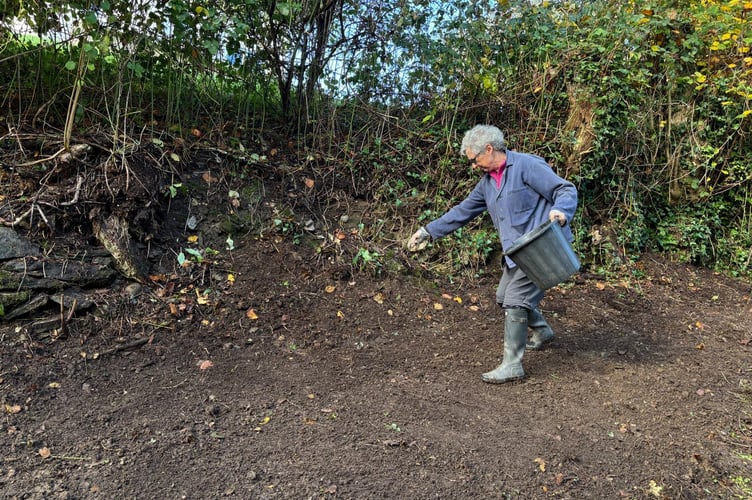
As a group of WAL-lies, as we affectionately call ourselves, we have run several family events this year, including moth trapping, insect surveys, lichen investigation, wildlife home construction and habitat creation. This autumn, we undertook a joint venture with Richard Barney, who is responsible for much of the essential management and maintenance work for the parish council, mowing verges to ensure safe visibility for both vehicles and pedestrians, trimming back hedges, keeping drainage channels clear, and many other tasks. On his regular upkeep visits to Lod’s Well, the spring-fed water source after which the village is thought to be named, he noticed how overgrown the adjacent area had become. At heart, Rich is a community man and recognised a neat opportunity for wider volunteer involvement. So he got in touch with the WAL team, met on site and discussed options to bring in more light, improve biodiversity and make it more attractive for the numerous walkers who pass by and those who come to collect its cool, naturally-filtered water. In turn,

the parish council agreed to fund the native wildflower seeds and bulbs needed for the project.
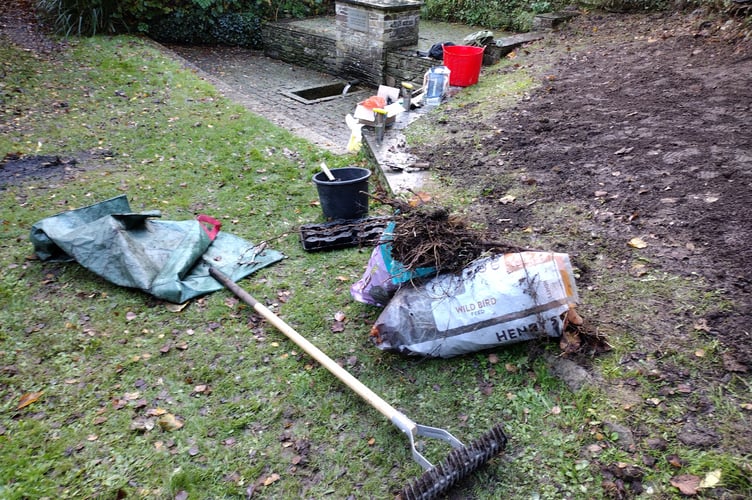
A work plan was agreed. Rich undertook the not insignificant task of cutting back the vast tangle of bramble and nettle, finally uncovering an old stone retaining wall. A few days later, the WAL volunteers assembled; seven in total – not bad! Our first job was to dig up nettle roots to reduce competition with the seeds we would sow later. This was where the fun started as we began to compare the tools we had brought along for the task. Liz and I had both brought root-slayer spades with narrow, serrated blades, roughly similar in shape to traditional Devon shovels and perfect for stony soil. Paul seemed to have a bespoke tool for every task, some painted in bright, unusual colours so he wouldn’t lose them. We all worked hard and between us filled two compost bags with tough yellow nettle roots. Next, we planted home-grown ox-eye daisy and primrose plants around the margin then shared out nearly three hundred bluebell bulbs between us. Paul suggested using the Monty Don approach of throwing them out in handfuls to be planted where they fell, producing more natural groupings. We then paired up to pop them in the earth. Again Paul had the perfect tool for the job, a long-handled dibber made from a sharpened broom handle. Once done, the earth was raked to leave an even, roughened surface ready to receive the seed.
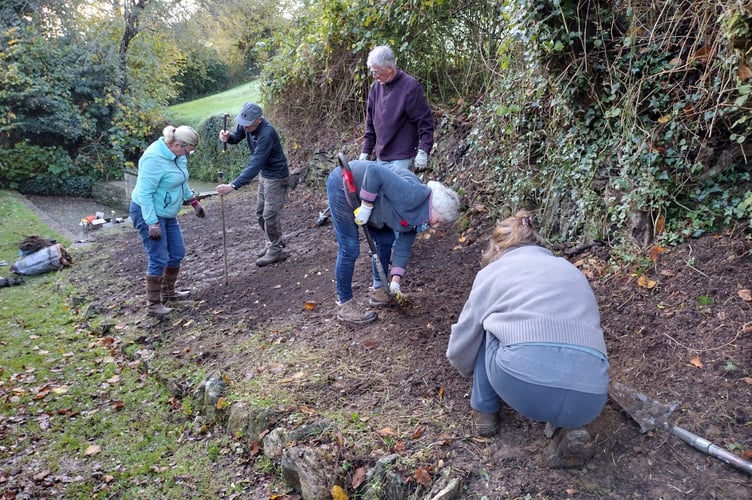
The area around Lod’s Well is quite shaded with mature shrubs and tall trees so we had opted to purchase two different native seed mixes. The first, sown closest to the wall, contained woodland species suitable for deep shade, including Wild Angelica, Wood Avens, Foxglove, Meadowsweet and Betony; the second, ‘hedgerow and light shade’ mix, including many of the same species with the addition of Knapweeds, Mullein, Musk Mallow and Self-heal, was sown adjacently.
It was with great satisfaction that we surveyed our completed handiwork and shared the standard payment for conservation volunteers: hot drinks and biscuits. Even better, we had running water on hand to clean up our mud-caked boots and tools before heading home! Now it is up to nature and time to do their work, and for Rich and the WAL-lies to keep an eye on progress and liaise on management. I know from experience not to raise my expectations of spectacular results too much for year one, maybe not even year two, but to be patient, observant and most of all, to keep heart.
Comments
This article has no comments yet. Be the first to leave a comment.