

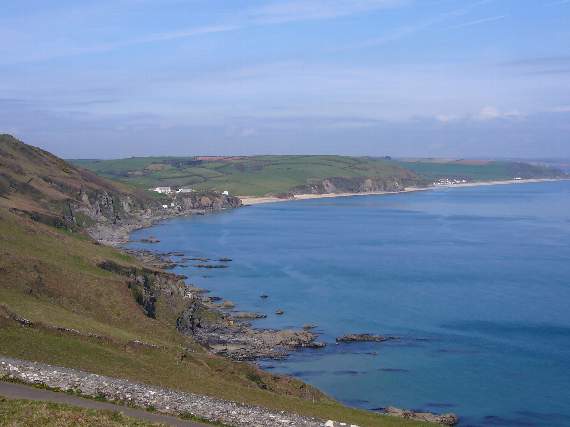
A COMMITTEE overseeing the South Devon Area of Outstanding Natural Beauty has been branded ’arrogant’ after rejecting calls for local people to have a greater say in planning.
At a meeting of the AONB Partnership Committee last Friday Bob Harvey, who represents amenity groups like the South Hams Society, Modbury Society and Aune Conservation Association, forced a debate on the way planning is handled in the area.
Urged on by around 20 public supporters, Mr Harvey demanded the formation of a technical group made up of volunteers that live and work in the area, which would feed their views on individual planning applications to AONB staff. These would then be submitted to planning authorities as representing the view of the AONB.
Mr Harvey argued this would boost the role of the AONB in the planning process, and give a voice to the Partnership Committee and local people.


The AONB Unit currently only responds to applications it deems would have a significant impact on the character of the area, or establish an important precedent for future development.
Mr Harvey and many of those he represents feel the AONB is not fulfilling its legal duty to protect the landscape from development to the same extent as national parks, and focusing too much on other projects. Their position was given greater weight by a National Trust report published last year, which said AONBs were failing to do enough to protect landscapes through the planning process.
However, Mr Harvey’s fellow Partnership Committee members gave his repeated calls for a technical group short shrift at the meeting.
AONB manager Roger English said the level of protection of the area was not directly linked to the number of responses made. He said final decisions were made by local planning authorities, and he and others emphasised that such decisions were a balance, that would at times see harm to the AONB outweighed by other factors.
But Mr Harvey said there was ’a gulf’ between what the AONB Unit considered to be the greatest threat to the area, and what everyone else considered it to be: bad planning. He added ordinary people saw the Partnership Committee as ’arrogant’, and it and the AONB Unit had to be prepared to go against council planners and the committees making planning decisions, in order to oppose development proposals.
He told fellow Partnership Committee members that over the years, they had not delegated but abrogated responsibility to the AONB Unit. He continued: ’I have a vision of driving from Slapton to Salcombe through a continuous suburban housing estate. I want to stop that happening.
’People want involvement in individual planning applications. Volunteers should be heard and valued. We’re finished with autocracy, we want the voice of the people to be heard here.’
Applause followed this speech.
Committee member Val Mercer, representing parish councils within the AONB agreed a technical group would be very useful. She said parish councils did not have a ’single track’ but all thought differently to one another.
But, she added parish councils did like some of the projects the AONB had carried out, which helped raise awareness of the AONB, and helped people understand its value.
She said: ’Since I’ve been here, the South Hams has been degraded, along with every other landscape. We have to realise there are forces beyond our control, we have to decide what the AONB can actually do.
’For all planning decisions to come back to this committee would create an enormous delay.
’This used to be a really good council, but it’s been emasculated by central government.
’Sherford - why the hell was that allowed? And the other new town near Exeter. We need houses, but also there are too many second homes here. A small, active technical group could help us find common points that would actually count. Do we want a Mr Trump to come and tell us in four letter words what to do?
’Let’s all try to make our AONB actually work for everyone that’s here.’
Partnership Committee member Cllr Jonathan Hawkins, who represents Dartmouth and Kingswear at Devon County Council and Dartmouth and East Dart at South Hams, said he supported most of what had been said.
He continued: ’We’re lucky to live in the South Hams, but we’re lucky because we can afford to live here. We have to balance it all.
’I am a supporter of development - I apologise. For a real community you need a church, a school, a shop and a Post Office, and many of our communities have already lost that.’
He added that if you went to Yorkshire, the Pennines were surrounded by wind turbines - but people there had accepted it.
He did not think the committee could discuss every planning application in the AONB, but contentious ones could perhaps be flagged up to members.
Mr Harvey clarified he wasn’t suggesting all applications should be discussed by the committee.
South Hams councillor for Woolwell Nicky Hopwood said that planning authorities were ’constrained completely’ by the National Planning Policy Framework, a piece of legislation brought in in 2012.
The bottom line, she said, was that if a planning committee goes against its officer’s recommendation, the planning authority will be left to pay costs - ’which are substantial’ - in the event of a successful appeal.
The Plymouth and South West Devon Joint Local Plan, currently being drawn up by Plymouth, South Hams and West Devon Councils, was according to Cllr Hopwood ’where we can stop urban sprawl and ribbon development’.
She continued: ’We can’t stop small developments in villages, and I don’t think we should. Our villages need life, they need young people. If it’s an application for five houses in a village in the AONB, we have to accept there’s nothing we can do about that.’
She added that ordinary people could have an influence on development through the neighbourhood planning process. Addressing members of the public, she said they were not allowed to speak in the meeting as observers, but they could go to their neighbourhood planning group and have their voices heard.
She continued: ’The Government is forcing housing on us - it’s a fact. South Hams Council has no choice. I agree, if there’s a major application in the AONB, it wouldn’t be too arduous for Roger English to consult committee members.
’But I don’t agree that volunteers should support planning responses. There are so many different laws in planning, and members are trained. If you go out to the wider community you’re not getting trained people, you’re getting individual voices. And if you go to the people in a specific area, you’ll get an insular view.’
She finished: ’The whole of the South Hams is precious, not just the AONB. The more meetings and groups we create, the less time there is for AONB staff to get on with their day job.’
Mr Harvey responded planning authorities were not constrained entirely by the NPPF - the law stated AONBs should be protected to the same level as national parks. He added comments should be made by the Partnership Committee, not just AONB officers.
Kathryn Deeney of Plymouth Council said that ways to override the NPPF, which stipulates planning authorities must demonstrate they have five years’ supply of land available for development, were ’few and far between’.
If they cannot demonstrate this, the NPPF makes it much more difficult for councils to oppose development.
The city council officer said the joint local plan was the way to get the much-needed five years’ land supply.
She paid tribute to Roger English for his input into the plan, helping to get policies relating to the AONB right, and said he should not be ’distracted’ at this key time. She said: ’The frustration of decisions we can’t defend because of land supply will disappear, if we get the joint local plan right.
’Anyone can make an objection, and any objection containing material planning considerations has to be taken into account.
’It’s great to see so many people here today, and I would say - please respond to planning applications.’
South Hams councillor for Wembury and Brixton Daniel Brown, the youngest person in the room by some margin, spoke passionately of how he wanted to see the South Hams become ’a hive again, of young families living and working here’. He continued: ’We need to ensure more young people have the opportunity to bring families up and remain here. We need to cultivate young communities in the AONB, which are at risk of dying off.
’We do need development in the AONB, but developers need to be responsive to the area and sympathetic to the landscape. They need to see it as an area for young families.’
Devon County Council officer Peter Chamberlain said that everyone agreed on much that had been discussed. However, he said the Partnership Committee primarily had a strategic role, and he would not want to do ’anything in terms of navel gazing’ that would distract people from its main purpose.
A vote was held on the formation of a technical group, with five votes against and one, Mr Harvey’s, for.
Speaking afterwards, he said a meeting was now being arranged, independent of the Partnership Committee, in February, where groups like the Campaign for the Protection of Rural England and the South Hams Society would discuss how the AONB should respond to the National Trust’s report.
He added: ’I’ve said to the AONB, I want to work with you through a technical group, but you’ve said no. We’ll either work with them or against them, so now we’ve got to do it from the outside.’
Keith Turner observed the meeting. Afterwards, he said: ’My assessment of the meeting was a succession of representatives of local and regional, publicly funded bodies voicing opinions to defend their turf.
’The NPPF clearly states the AONB has the highest level of protection unless exceptional circumstances prevail. The members of the public were at the meeting to support Bob in getting the message across, that the committee was failing to apply the proper levels of protection.
’The message fell on cloth ears.’
Another member of the public Elizabeth Bennett said: ’I have been a supporter of the AONB for many years but have become increasingly disillusioned by the ineffectual handling of the issue of planning.
’The purpose of the Partnership Committee surely, is to direct the AONB manager to employ staff who are qualified in planning, so all planning applications in the AONB are examined and the strongest possible pressure is brought to bear on South Hams Council’s Development Management Committee to follow AONB recommendations, which will respect and give the highest possible value to the landscape and beauty of the AONB.
’There is no doubt the DMC repeatedly fails in its duty in this regard and recommendations made by the AONB are frequently ignored.
’Groups which are represented by Bob will, no doubt, be very disappointed in the reaction to his proposal.
’I do believe there is a groundswell of opinion in the South Hams regarding the lack of care for our stunningly beautiful AONB. If planning abuses are allowed to continue at current rates, then the AONB’s status will be lost and the goose that lays the golden egg of tourism will have flown its nest.’
A spokesman for the AONB Unit said: ’AONBs have the same level of protection as National Parks in both law and policy. However AONBs are all very different from each other, and National Parks are also very individual. Dartmoor for instance is mainly characterised by extensive open areas but the settled areas of National Parks are under significant pressure from development and there are housing allocations being made in these areas as well as other AONBs. ’Where National Parks do differ is that they are also local planning authorities and local authorities in their own right.’
The spokesman said the AONB was incorporating recommendations and a series of tests from the National Trust report into planning responses, as well as into a draft ’Planning Guidance’ document and the AONB Management Plan. The unit hopes the guidance document will be adopted by South Hams Council, helping ensure the planning authority also applies the tests.
The spokesman added: ’As a Partnership Committee and staff unit the AONB really wants to ensure the highest quality of responses is submitted for those applications that would have a significant impact on the character of the AONB, or where they would be perceived as establishing an important precedent for future applications. We value the input of all our Partnership Committee members and the wider community of the AONB.’
Comments
This article has no comments yet. Be the first to leave a comment.