
Shocking aerial pictures showing the damage caused by recent storms to the sea road at Slapton have dominated news bulletins in recent days.
This is the story of one man’s tireless mission to create a fitting memorial to a forgotten wartime tragedy.
In the early hours of April 28, 1944, nine German torpedo boats attacked a convoy of American tank landing ships which were taking part in an exercise.
Large areas of South Devon had been evacuated of civilians and turned over to military use in preparation for the D-Day landings in Normandy.

-Cleared.jpeg?width=209&height=140&crop=209:145,smart&quality=75)
Slapton’s shingle beach was pressed into use for live-firing exercises due to its resemblance to some of the beaches on the French coast.
With just a few weeks to go before the massive D-Day operation, the tank landing ships were full of troops and vehicles for the exercise.
Two landing ships – numbered LST 507 and LST 531 – were sunk and another was severely damaged.
In all, 749 American troops were killed, many of them drowned due to the heavy packs they were carrying.
There had been failures in communication and in the execution of the exercise, and the incident was kept secret for decades.
Two Royal Navy ships had been assigned to protect the landing craft, but only one was present when the attack happened, the other having gone back to Plymouth for repairs after colliding with one of the landing craft.
The Exercise Tiger Memorial website explains that Ken Small first came to Torcross on holiday and fell in love with the place.
When the opportunity came to move there with his family, he jumped at the chance, selling his successful hairdressing businesses in Grimsby.
However, Ken suffered from depression and took to walking on the shingle beach at Slapton, beachcombing through the flotsam and jetsam he found.
Among his finds were shrapnel, bullet cases and tunic buttons, leading him to ask locals why so much military material was finding its way ashore.
In the early 1970s a local fisherman told Ken about an object on the seabed about three-quarters of a mile offshore and 60 feet below the surface.
Divers discovered that it was an American Sherman Tank which had become shrouded in fishing nets.
Ken Small became determined to recover the tank and create a lasting memorial, but it was a decade before he could persuade the US government to sell him the tank for fifty dollars.
In May 1984 he finally managed to raise it from the seabed.
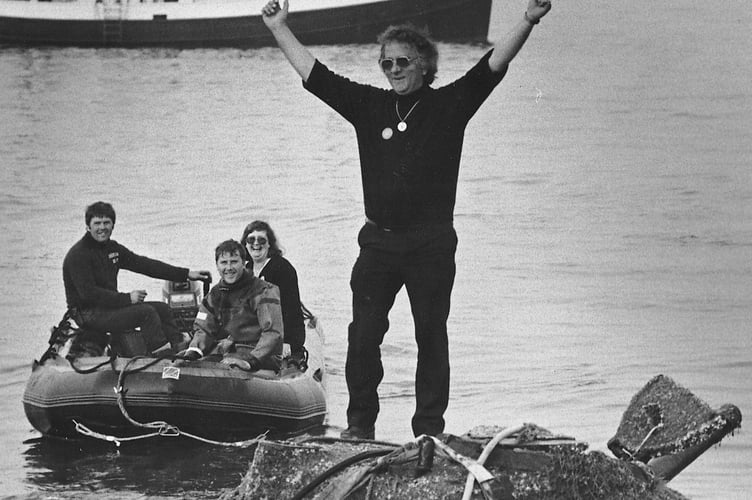
As the tank broke the surface, lifted upwards by huge flotation bags, Ken clambered aboard.
Wearing sunglasses and dressed in his trademark black sweater and gold medallion, he raised his arms in triumph for a photograph which has been published around the world.
Eventually the memorial was recognized by the US government, and every year a service takes place to remember the servicemen who died.
In 1988 he published a book called ‘The Forgotten Dead’ which tells the full story.
Ken Small died in 2004 at the age of 73, and a plaque commemorating his campaign was placed beside his Sherman tank and dedicated during a ceremony to mark the 70th anniversary of Exercise Tiger in 2014.
It reads: “With heartfelt thanks to Ken Small for his tireless determination over 30 years.”
Comments
This article has no comments yet. Be the first to leave a comment.