
The future of the Slapton Line now rests in the hands of Westminster, as local leaders admit they lack the resources to repair the collapsed road.
Further strong winds and an exceptionally high tide caused large sections of the A379 to collapse, along with part of the Torcross Tank car park.
The latest damage has caused devastation for residents, businesses and commuters who rely on the coastal route, which links Torcross to Strete and forms part of a key transport corridor between Kingsbridge and Dartmouth.
Devon County Council has confirmed that the damage is being assessed, but the scale of the collapse has raised fresh questions over whether the road can realistically be repaired at all.

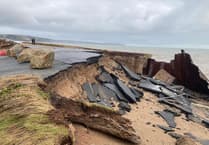


The Slapton Line has been repeatedly damaged by storms in recent years and has long been acknowledged as vulnerable to coastal erosion.
Cllr Julian Brazil, Leader of Devon County Council and ward councillor for Stokenham, said he fears the area may now be “past repairs”, although his immediate concern is for those directly affected.
“Right now, my thoughts are with the people whose lives have been affected by this,” he said.
Cllr Brazil said support would be made available to those affected in the immediate aftermath, although details of what form that support will take, and where funding will come from, have yet to be confirmed, at the time of writing.
On Tuesday, February 3, Cllr Brazil, Devon County Council Chief Executive Donna Manson and South Devon MP Caroline Voaden visited Westminster to discuss the situation facing Devon’s roads and to seek central government funding support.
Multiple members of local government have said it is now clear that Devon County Council and local authorities do not have the resources to deal with the scale of the problem alone.
“What happens next relies heavily on government support,” Cllr Brazil said. “This is not something we can fix with local budgets.”
While the collapse may signal the end of the Slapton Line as a through-road, Cllr Brazil stressed that the area itself will not be lost and could still thrive as a destination.
He said there is potential for Slapton Sands and the surrounding area to develop further as a destination for water sports and outdoor recreation, adding that reduced traffic could even improve the area in the long term.
“Difficult decisions must be balanced with looking forward realistically,” he said.
Cllr Brazil has consistently argued that the focus must shift towards resilience and adaptation, particularly to protect Slapton Ley, the largest natural freshwater lake in south west England, which is separated from the sea by the road.
“There are two things that need to happen,” he said previously. “The first is to protect the line for the Ley, and the second is to work on a comprehensive adaptation plan.”
Stagecoach South West has confirmed that a temporary bus service will continue to operate following the collapse.
The 93 service will now run between Kingsbridge and Strete before continuing on to Dartmouth, ensuring ongoing access to the area, although long-term transport arrangements remain unclear.
As the community comes to terms with the latest devastation, attention is turning to how Slapton can be supported through what may be the end of the road as it is known, and what role central government will play in shaping what comes next.
Comments
This article has no comments yet. Be the first to leave a comment.