

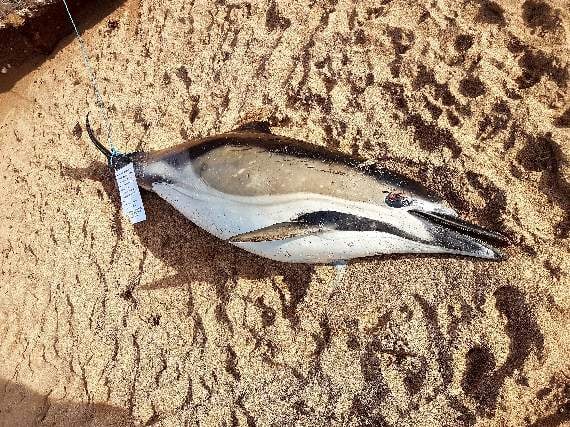
A common dolphin washed up at Thurlestone Sands on Monday and is thought to be a victim of bycatch.
The dolphin was spotted on the beach and reported to Brixham Seawatch, who keep track of cetaceans (whales, dolphins and porpoises) that wash up on the shores around the South Hams.
It is hoped that the animal will be picked up by the National History Museum for a post-mortem to establish how it died, but Lindy Hingley of Brixham Seawatch said it was “probably” a victim of bycatch.
Bycatch, in the fishing industry, is a fish or other marine species that is caught unintentionally while catching certain target species or target sizes.




The World Wildlife Fund says on their website: “Wherever there is fishing, there is bycatch—the incidental capture of non-target species such as dolphins, marine turtles and seabirds. Thousands of miles of nets and lines are set in the world’s oceans each day.
“Modern fishing gear, often undetectable by sight and extremely strong, is very efficient at catching the desired fish species—as well as anything else in its path.
“A staggering amount of marine life—including turtles, dolphins and juvenile fish—is hauled up with the catch, and then discarded overboard dead or dying.
“Fishing industry leaders increasingly realise the need to reduce this phenomenon. Proven solutions do exist, such as modifying fishing gear so that fewer non-target species are caught or can escape. In many cases, these modifications are simple and inexpensive, and often come from fishers themselves.
“Despite new technologies and industry recognition of the issue, bycatch is still a major problem. Not only does it cause avoidable deaths and injuries, but the fishing methods can be harmful to the marine environments where they are employed.”
Comments
This article has no comments yet. Be the first to leave a comment.