
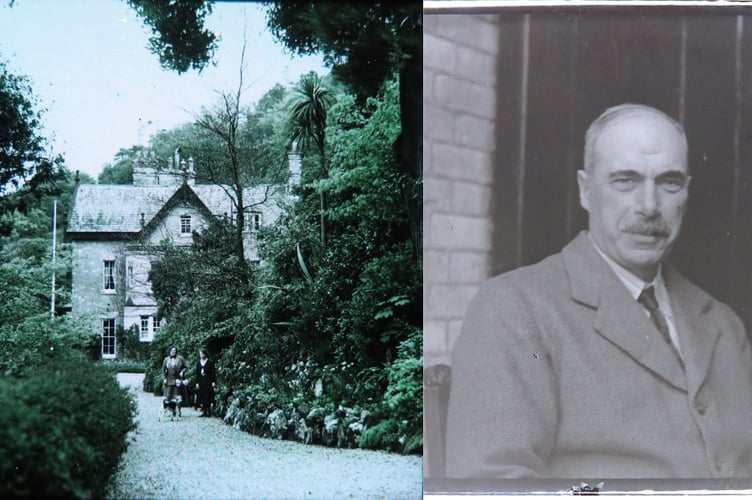
When a large photographic archive was donated to Dartmouth Museum in December 2025, it opened an unexpected new chapter in the town’s cultural history — and in the life of a familiar name in Dartmouth’s maritime life.
Vernon MacAndrew is remembered locally as a businessman, yachtsman, and philanthropist; living at Ravensbury, Warfleet, 1922-40.
At the outbreak of the war, he offered his motor yacht Campeador V to the Auxillary Patrol Services, and despite being 58 years old, volunteered to serve aboard her, together with two other members of the Royal Dart Yacht Club.
They served with distinction, for 85 of the first 90 days of the war.


Unfortunately, Campeador V struck a mine off the Isle of Wight in June 1940, sinking with the loss of 20 of the 22 crew, including MacAndrew.
However, what has not been known until now is that alongside this public life, MacAndrew pursued photography with remarkable commitment for over thirty years.
But in 2025 Dartmouth Museum was offered the archive by Scottish antiques dealers Scott Trotter and Christine Clayden. The Museum identified a private donor, Alec Smith, an experienced book collector and member of Dartmouth Museum, who said “I’m delighted to have been able to transfer the complete archive to the Museum, so it can be kept together for Dartmouth.”
The archive dates from 1900 to 1940, and comprises 4,500 photographic images, in black-and-white, hand-tinted colour, and most excitingly a large number of early colour slides.
These include vivid colour views of Dartmouth and Kingswear, the harbour, fishing trawlers, working boats, and waterfront life in a way rarely encountered from this period.
There are also extensive sequences of yacht racing, maritime industry, domestic life, travel abroad, and studies of natural history subjects.
What makes the archive particularly significant is not only its scale, but the breadth of subjects covered, and the number of early true colour images.
In addition, the archive has not been studied since his death: the photographs were owned privately and have only now entered public care.
According to Dartmouth Museum, the donation is the start of a project rather than a finished story.
The immediate priorities are conservation of the archive and the creation of a inventory.
Only once this groundwork is complete will it be possible to assess the archive’s wider significance within British photographic history.
“This is an important addition to the town’s historical record,” a museum spokesperson said. “It offers a rich visual account of Dartmouth’s maritime world, but it also raises wider questions about early colour photography and private photographic practice.”
“The archive was largely created, curated and kept in Dartmouth and is still in its original storage cabinets.
Having left Dartmouth after the war, it is wonderful that they are returning home.”
For Dartmouth, the donation represents more than the arrival of a collection.
It offers a rare opportunity to see the town’s past — quite literally — in colour, and to reassess a familiar local figure through the newly uncovered work of a resident with a keen eye for maritime and coastal photography.
Comments
We've recently changed our login process. If you have an account for commenting, you will need to re-register on the login window.
This article has no comments yet. Be the first to leave a comment.