

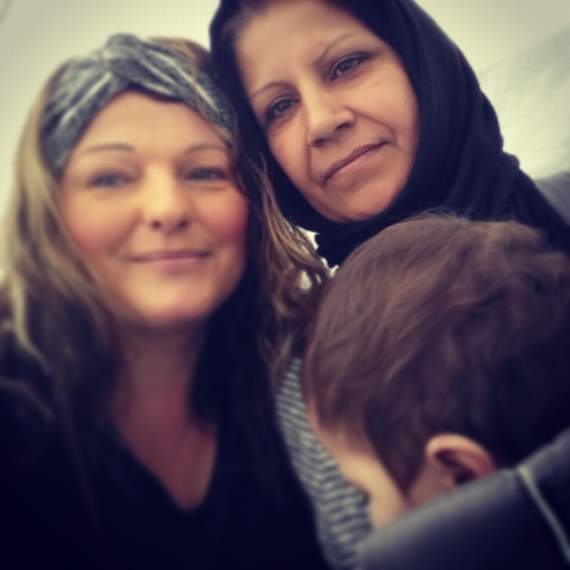
THE Kingsbridge restaurant owner who travelled to Lesvos, Greece, to help the refugees has given a talk about her experiences.
Juliet Bill travelled to Greece alone in November, pushed by a need to help the innocent people arriving at the island of Lesvos by the boatload every day.
A group of around 20 people gathered upstairs at the Old Bakery in Kingsbridge to hear Juliet speak about her ten-day trip. There were tears, both from Juliet and her audience, expressions of anger at the situation and offers of help.
Juliet began by explaining the journey to Lesvos that the refugees take. They pay an ‘exorbitant’ amount of money to take the sailings. These were middle and upper class people in their own countries. The poor are too poor to leave.
.jpeg?width=209&height=140&crop=209:145,smart&quality=75)


They arrive, fifty to sixty to a boat designed for 18; men, women and children. The lifejackets they have on, which they pay for, are fake. ‘They say Yamaha on them, they’re not made by Yamaha’, said Juliet, ‘we opened one up to see what was in it and it was stuffed with carpet underlay. If anything is not going to save your life, its one of them.’
Juliet, who spent her time volunteering in a medical tent, said she saw a lot of injuries just from the landings.
‘They have lacerations from the rocks’ she said, ‘broken bones, they’ve lost relatives, they stand on sea urchins and after they land, they have a 20km walk from the beach, with those injuries, to the camp. By the time they arrive their feet are bleeding and many have trenchfoot.
‘To add serious insult to injury’, said Juliet, ‘in this chaos of the landings, there are now human traffickers donning a volunteers’ high-vis vest and taking the prettiest children off in a speedboat, so I am now helping a few groups who have been set up to try and find lost children.
‘If parents are split up in the chaos and end up in different camps, there is no one that is going to help reunite them. Their precious mobile phone, with all their contacts and photos in, are usually ruined in the wet, so if they get split up, there is no way of contacting each other once they reach the shore.’
There is a coach supplied by the UN to ferry people from the landing area to the camp, but its not free. It costs around €20 per person.
When people leave their homes, they cash in everything, but after the people smugglers, the robbers, the exorbitant costs, having to live in Turkey for a few months before crossing and the sea, they usually arrive with next to nothing, so most decide to walk and spend their €20 on food.
Juliet continued: ‘They’re hypothermic, freezing, soaking wet and had pneumonia. The crossings take about 12-hours, with people sitting waist-deep in filthy seawater for that time, causing real trouble for women especially – a lot of antibiotics were needed.
‘One of the reasons I was asking for tracksuits, is once they land, freezing and wet, they need instant warmth, you can’t put a pair of jeans on a little wriggling body, you need something quick.’
Sometimes, up to 60 or 70 boats come in to the island every day. Juliet explained that a lot of people arrive and don’t know which country they were in. They would ask her ‘this Sweden?’ or ‘this England?’, ‘the minute they decide to flee, whether from Syria, Afghanistan, Pakistan and beyond, they are following a herd, like a migration, and have no idea where they are or where they’re going.
‘I saw people queuing up for three hours, and not even knowing what they were queuing for, because whatever it is, they want it, and the lack of information was so frustrating.
‘If a boat capsizes out at sea, its not the military, its not the coastguard, it’s the Greek fisherman that go, at their own expense, on their own time, to pull people from the water.’
Juliet then explained the layout of the camp, which houses around 6,000 people. There is a central camp, the UN camp, which is protected by razor wire and armed guards. Only the very sick or very vulnerable are allowed in.
Juliet was working in a medical tent – a garden marquee with Aldi sun-loungers as stretchers and a mud floor.
On a couple of occasions, Juliet had to take an ill child to the UN camp. She picked up little boy who had severe vomiting and diarrhoea, one of the doctors she was working with put a stethoscope around her neck – ‘the international sign of a doctor’ Juliet laughed – and walked into the camp to beg that they take him.
The camp has no toilets, no showers, no electricity and no heating. The lack of toilets really struck a chord with the gathered audience – surely that would help the spread of disease?
Juliet then showed us a photo of the UN ‘luxury’ toilet block, which apparently quickly descends into filth and chaos due to the amount of people needing to use them.
Once people arrived in the camp, they queued for days, not hours, for registration. Mostly it was the family representative who would queue, leaving the women and children in the camp. Once they were registered and had their papers, they could move on with their journey.
The one thing Juliet was able to do was to give people some dignity back. Washing products, baby wipes, talcum powder, chewable vitamins and medication if they needed it. ‘Knickers!’ she said, ‘Socks and knickers, I can save the world with my knickers!’
One man, whose family of eleven had made registration the day Juliet arrived, upset his whole family by staying another four days because he wanted to help the volunteers.
His name was Saif, and he had been a translator for the US army in Afghanistan for five years, and had then been abandoned by them when they didn’t need him anymore, so he had fled with his family.
He would thank Juliet and her team ‘with tears in his eyes at the amazing work we did’. Juliet explained: ‘He told all the refugees that came to our medical tent that we were angels, that we shared our food and drinks with them, didn’t stop working and never sat down.
‘He said he couldn’t leave us until he had found a suitable replacement for himself. Not only was he our translator, but he slept in the tent guarding thousands of pounds worth of medical kit.’
On the day of her talk, Juliet had just heard that he had made it to Berlin and was safe. ‘Safe’, Juliet said, ‘apart from he probably has twenty years of Islamophobia to contend with, but he’s safe in Germany.’
One lovely story to come out of Juliet’s talk was a elderly man who had come in to the tent and the doctor was trying to listen to his heart, and couldn’t work out what the strange noise was. Being Greece, there are hundreds of stray cats, and this man had a kitten in every pocket. ‘My friends’, he called them, ‘my friends’.
Juliet is aiming to return to Lesvos in January to continue her work, by which time, in winter and with the rains, the situation will be a lot worse.
At the talk, Juliet met a woman she called an ‘inspiration’. In her 80s, she doesn’t own a television, she certainly had never used the Internet, she was a refugee child to refugee parents fleeing France in the ‘40s.
‘She announced to me that she has already cleared three bedrooms in her house in anticipation of housing a refugee family’ said Juliet, ‘for "as long as it takes for them to feel at home and able to make it on their own".’
The people of the Greek island of Lesvos have been nominated for a Nobel Peace Prize, and Juliet hopes they get it.
‘The Greek people were lovely’, said Juliet, ‘there were four Greek grannies, dressed all in black, who would make up a huge batch of soup to feed the refugees every day. If anyone arrived who was not completely on side they would get shooed away with a wooden spoon!’
Juliet said that anyone can go out to help. If you have a spare two-weeks and around £600 including flights and you don’t mind roughing it a little bit, you could go and help. Juliet organised her trip with the help of Health Point Project, a group of NHS nurses and doctors, self-funded, who are out there helping the refugees.
Juliet has set up a JustGiving page to raise money for her next trip, to buy food, warm, dry clothes and medication while she is out there. She tries to buy as much as possible while she is there, to help the Greek economy.
To donate, visit: crowdfunding.justgiving.com/Julietcbill.
Comments
This article has no comments yet. Be the first to leave a comment.