

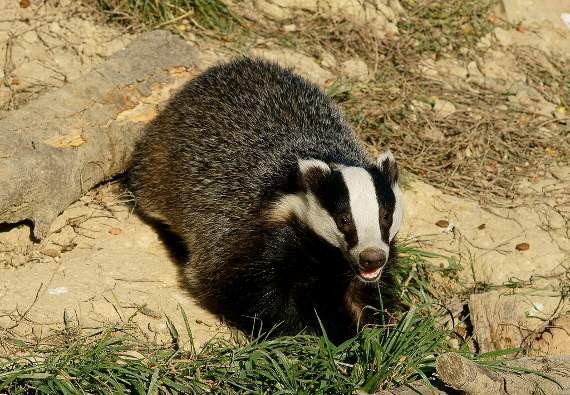
BADGER culls are to be carried out across the South Hams in a bid to control bovine TB, although animals rights groups have said 'there is no evidence that culling is effective'.
According to a BBC report this week, badgers will be shot by trained marksmen from early September, with culling companies currently being selected.
The Devon Wildlife Trust opposes the government’s badger culling programme, saying that ‘there is robust evidence that culling badgers will make the problem worse.’
In a statement published this week, a spokesperson said: ‘The DWT recognises the devastating impact that bTB has on farmers and rural communities.


‘Staff and volunteers at DWT work every day with people who are affected by bTB and witness first-hand the devastating impacts this disease has on farming communities.
‘DWT is also a landowner and relies on healthy livestock for conservation grazing to protect and restore threatened wildlife on many of our reserves.
‘DWT opposes the cull because we believe that there are more humane, more cost effective and more sustainable ways of tackling this disease effectively and for the long term.’
A South Hams farmer, who didn’t wish to be named, explained: ‘I think the cull will make a big difference.
‘We’re not taking part, we’re currently clear of bTB and are worried that culling the badgers would bring in infected badgers.
‘We had it seven years ago, but it was spread to our cattle through their food. ‘When I stopped using that particular feed, we stopped the spread of bTB.
‘When we picked it up, it was heartbreaking. We had to send away a cow that had just calved and another cow that was six weeks from calving. We had to feed the newly born calves with bucket feed.
‘Something has to be done, whether its too late or not, only time will tell.
‘My personal opinion is it’s ten years too late - wildlife has picked it up, although its probably too late for a lot of farmers.
‘It’s damage limitation at this stage, if this was done ten years ago, it could be different - it’s just been getting worse and worse for the past 15-20 years, spreading out across the country.
‘We don’t want to wipe out all badgers - they’re a part of the eco-system, it’s just that this is causing farmers a lot of stress and money.
‘Many farmers in the area have had a lot of trouble with the disease.
‘Something has got to be done, but I don’t know the right or wrong way.
‘There’s been an explosion in numbers since the badgers have been protected - and they have no natural predators, apart from the car.’
It is estimated that 50,000 badgers are killed on the roads each year in the UK, while almost 4,000 badgers have been culled in the last few years, none of which tested positive for bTB.
Hayden Macey, chairman and secretary of South Devon Animal Rights said: ‘DEFRA’s own data suggests that 15 per cent of badgers may test positive for bTB, with just 1.6 per cent of those badgers capable of passing on the disease.
‘98.4 per cent of those pose no risk to cattle, and 85 per cent are likely to be completely free of bTB.
‘Since 2013, the government has licensed the culling of 3,916 badgers in Gloucestershire, Somerset and Dorset at a cost to the taxpayer of more than £25 million.
‘That is £6,311 per badger killed - the most expensive wildlife cull of its kind on record. None of these badgers tested positive for bTB.
‘DEFRA statistics show that despite killing thousands of badgers, the number of cattle slaughtered for bTB continues to rise both in and around the culling zones.
‘We are adamant that the government should look to Wales, which has far more successfully campaigned against the disease based on more rigorous bTB testing, tighter cattle control and bio-security measures.
‘New bTB herd incidents in Wales are down by 14 per cent in the last 12 months, without culling badgers.
‘And Ireland is about to abandon its cull policy in favour of vaccination.
‘Licences have been issued in the South Hams and activists are gearing up for a campaign.
‘We plan to set up Camp Badger - a base for activists that use as a base from there, they go out on wounded badger patrols.
When asked why some farmers are pro-cull. Mr Macey said: ‘They’re just looking for an excuse to cull badgers, because it’s easier than improving bio-security.
‘Research conducted by Prof Rosie Woodroffe from the Zoological Society of London, on 20 farms in Cornwall tracked 400 cattle, and more than 8,000 badgers - and detected nothing in the way of interaction.
‘Only once in 65,000 observations did badgers get within ten metres of cows - they preferred to be 50 metres away - but need to be within 1.5 metres to directly transmit bTB.
‘We need to look at other causes, for example farmers spreading slurry across fields, infecting both cattle and badgers.’
Sean Wensley, president of the British Veterinary Association, said: ‘The BVA recognises the need to control the wildlife reservoir of disease as part of a comprehensive strategy to eradicate bTB.
‘Therefore, control measures in cattle must be accompanied by simultaneous and coordinated control measures in badgers and susceptible farmed species.
‘For these reasons, BVA supports the wider roll-out of culling to carefully selected areas where badgers are regarded as a significant contributor to the high incidence of bTB in cattle, through the use of cage trapping and shooting only; we do not support the continued use of controlled shooting as part of the badger control policy.’
A DEFRA spokesperson said: ‘Natural England is currently considering applications for further badger control licences as part of the usual licencing process.
‘England has the highest incidence of bTB in Europe and that is why we are taking strong action to deliver our 25-year strategy to eradicate the disease and protect the future of our dairy and beef industries.
‘Badger control in areas where bTB is rife is one part of our long-term plan, which also includes strengthening cattle testing and movement controls and improving biosecurity on farm and when trading.
‘This comprehensive approach has worked overseas and is supported by the government and DEFRA chief scientists and leading vets.’
The Stop the Cull group is now planning demonstrations in the South Hams between September 16-18, although the exact location and details are yet to be announced.
Comments
This article has no comments yet. Be the first to leave a comment.