
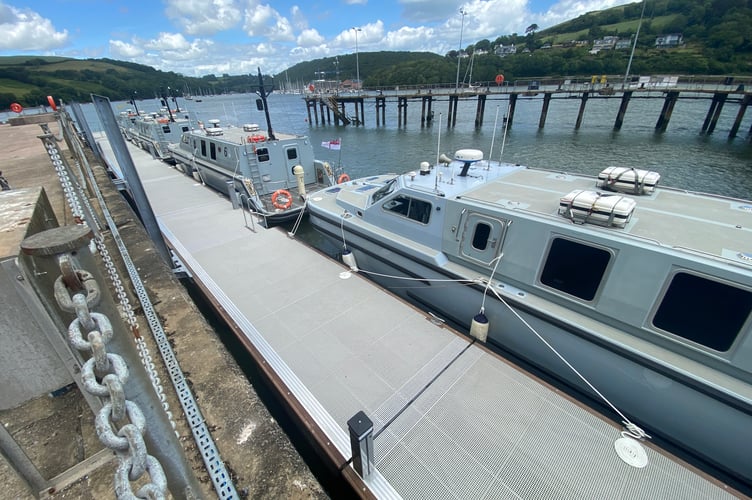
A brand new pontoon facility has been officially unveiled on the River Dart today, securing the long-term future of Royal Navy officer training at Dartmouth after deteriorating infrastructure had severely restricted water access.
The state-of-the-art facility, situated at Sandquay in Dartmouth, was opened during a formal ribbon-cutting ceremony by Captain Andrew Bray, Commanding Officer of Britannia Royal Naval College (BRNC), and Paul Britton, Chief Executive of the Dart Harbour & Navigation Authority.
The installation is part of a sweeping naval modernisation programme aimed at transforming cadet instruction.
Prior to its construction, a crumbling training infrastructure had left Britain’s future naval officers unable to launch directly onto the water from the college for several years.

.png?width=209&height=140&crop=209:145,smart&quality=75)

Instead, cadets had to rely on an inconvenient town centre berth half a mile away or a single, highly unreliable pontoon.
Captain Bray hailed the new structure as a major engineering achievement that reflects a deep, collaborative partnership between the college and the surrounding Devon community.
"This is part of a much wider project the Navy is going through at the moment to recapitalise across the establishment and modernise our training," Captain Bray said. "Operating and doing engineering in or near the water is never straightforward. It does take a lot of planning, a lot of collaboration, and a lot of teamwork to produce big facilities like this".
The new asset will significantly boost the pace of operations at BRNC, ensuring its twenty-strong fleet of Officer Training Boats - including the advanced Vahana craft - can be deployed safely.
The Vahana vessels carry modern technical systems identical to those found on Royal Navy destroyers, making immediate river access a critical element of tactical training.
"The key for me is it means that more of our cadets can get onto the ships and onto the water more often and more quickly than they could before," Captain Bray explained. "It means we can do more training throughout the year".
The project was delivered via an innovative commercial partnership over three years of intense layout discussions.
Under the finalised agreement, the Dart Harbour authority funded over £300,000 and installed the structure, which will now be leased back to the Royal Navy.
This arrangement ensures that the specialist harbour team will handle all long-term maintenance, saving naval budgets from additional technical overheads.
Paul Britton, Harbour Master and CEO for Dart Harbour, emphasised that keeping the Navy firmly rooted on the river was a core priority for the trust port, ensuring the famous college remains viable at Dartmouth "for the next 100 years".
"The cadets are going to use it hard. They're going to be bashing their boats into it, and that's all part of learning how to drive on the river," Mr Britton said. "So we've built it nice and strong".
Engineered to withstand intense daily training, the heavy-duty pontoon incorporates a highly modular design where every component can be individually replaced as it wears out.
It features a robust steel frame supported by expanded polystyrene covered in concrete for buoyancy, topped with a fibreglass coating for a slip-resistant surface.
The strategic asset will immediately support core tactical curriculum exercises, including the college's historic "war games" manoeuvres where cadets plan and coordinate defences between Kingswear and Dartmouth, marking the beginning of their professional seafaring careers.
Comments
We've recently changed our login process. If you have an account for commenting, you will need to re-register on the login window.
This article has no comments yet. Be the first to leave a comment.