

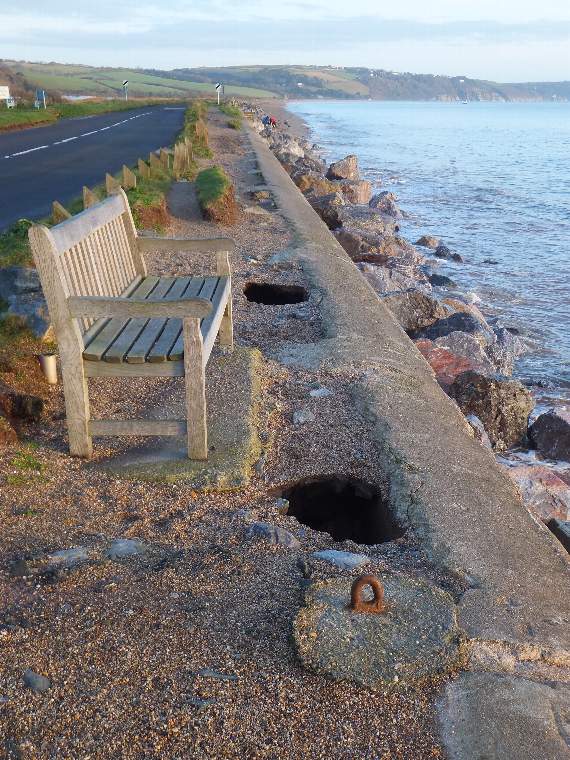
TWO large holes have appeared next to the road at Torcross as the sea begins to undermine it.
The sea wall, which separates the Slapton Line road from the beach, had Heras fencing preventing anyone accessing the two benches that are positioned there, as two large holes appeared on Thursday night.
Fanny Earle, a Chillington resident, said: ‘My neighbour, Julia Kelland, went down to Torcross early to take photos of the sunrise and she noticed how the sea was surging in and out of a gap at the base of the sea wall.
‘Up above, between the two benches were holes that were getting bigger as the sea surges were washing away the sand.’


Fanny explained that Julie had called the council to report the situation and later the same day, lorries and bags of sand were on site, the Heras fencing was up and traffic lights kept cars away from that section of the road.
South Hams Council say that Devon County Council has made temporary repairs to the holes in the sea wall and that they are currently discussing a permanent solution with DCC and the Environment Agency.
South Hams District Council spent £250,000 of emergency flood funding in January 2014 to move 25,000 tonnes of shingle from one end of Torcross beach to the other in a bid to protect sea defences in the area.
The damage at North Hallsands has also continued, with much of the peat exposed last week being washed away, leaving a large hole in the beach.
A local landowner, who asked not to be named, explained that he thinks the shingle moved at Torcross would have been better placed at Hallsands or further along the coast. ‘The sea moves everything from here down to Torcross and Dartmouth’, he said, ‘at least if they dumped it here, some would have ended up at Torcross’.
He also said that they are hoping for northeasterly winds to bring some of the sand back to the beach.
Professor Gerd Masselink, Professor of Coastal Geomorphology at Plymouth University, said that just because the shingle moved along the beach in 2014 wasn’t visible, didn’t mean it had gone completely, ‘its still in the system’, he said.
He suggested that a ‘large scale nourishment plan’ of placing gravel at Torcross or possibly at Beesands would allow it to ‘trickle up’ the coast, but he said you would probably need ‘ten times’ the 25,000 tonnes of material used last time, and he couldn’t say ‘how long it would take to make a difference’.
Professor Masselink went on to say that ‘feeding the beaches from the southern end’, moving the shingle down, waiting for it to move to Strete Gate or Blackpool Sands and then repeating, could be an effective course of action, but moving it to Hallsands would ‘be acting against policy and wouldn’t make sense’, due to the no-intervention policy at Hallsands in the Shoreline Management Plan.
Talking about the road between the beach and Slapton Ley, Professor Masselink said ‘I’d be worried if I lived there’ and that it wasn’t a case of ‘if the road went, but when’ and a lot depended on management decisions and what the waves are doing.
He said the holes in the wall, created a ‘real worry’, and that most sea walls fail from behind when the sand is washed away. He said the sheet piling – the red metal seen below the village of Torcross on the sea wall – was designed to prevent that happening as they are buried very deep into the mud, but that the area where this has occurred is past where that piling ends.
He agreed that what was needed was easterly and northeasterly winds and waves to bring sand and shingle back to the beaches.
Talking about the peat at North Hallsands, he called it a ‘nice coastal geomorphologic feature as it is five to six thousands years old’, but as it washes away, it could be a permanent loss, as the peat would not be replenished like the shingle and gravel.
This could cause ‘a bit of a flooding issue’, by reducing the height of the beach.
Comments
This article has no comments yet. Be the first to leave a comment.