

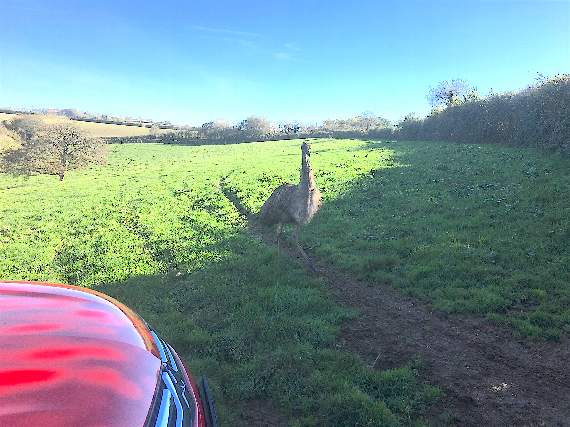
AN ‘emu-gency’ (sorry) occurred on Wednesday morning as an escaped emu made its way from Churchstow to Sorley Cross before being recaptured.
The bird, a female, escaped from its home in Churchstow on Wednesday morning and made its way to Sorley Cross, causing amusement and a small amount of chaos on its way.
The emu’s owner Carol Rowe contacted us to say it had been caught around midday. ‘Two police cars were out looking for her and she was cornered into a field near the new house being built at the top of Sorley Cross.’ said Carol.
‘She has an injury to her leg, which we will treat with antiseptic, but other than that she is alright. Its mating season, so we think she was trying to get away from the males, as they can get quite aggressive, when she escaped.



‘We’re keeping her separate from the others for a while so she can settle down, she’s in with the alpacas at the moment.
‘We’ve been all over looking for her, we got a call to say she was in Churchstow, then that she was at Palegate Cross, and she was eventually chased into a field by James Parker.’
James, from Parkland Camping and Caravan Site on Sorely Cross, said: ‘We got her into a stock-proof field and tried to catch her, but its difficult! I told the owners they should take up keeping chickens, they’re much easier!’
Emus are the second-largest living bird by height, after the ostrich, and are native to Australia. Soft-feathered, brown and flightless, with long necks, they can reach speeds of up to 31mph and eat plants and insects.
They lay large, green eggs, around 13x9cm, which can weigh between 450-650g. Newly-hatched chicks stand about 12cm tall and can leave the nest within a few days of hatching. They grow quickly and are fully-grown in five to six months, and stay with their family units for an extra six months or so before split ip to breed in their second season. During their early life they are defended by their father.
Emus have always been a source of food for humans by indigenous Australians and early European settlers and are now farmed for their meat, leather, feathers and oil. 95 per cent of the carcass can be used.
Comments
This article has no comments yet. Be the first to leave a comment.